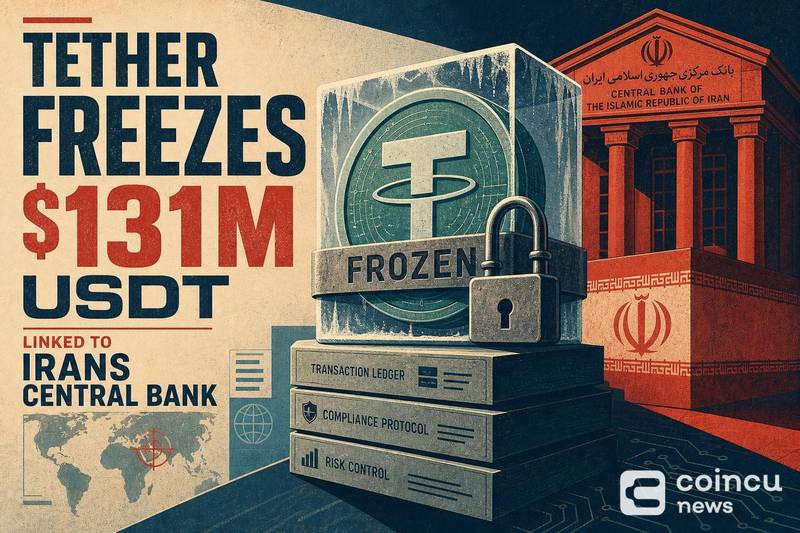
Tether has frozen $131 million in USDT held in cryptocurrency wallets that U.S. authorities linked to Iran's central bank, after the Treasury Department added four addresses to its sanctions
Tether has frozen $131 million in USDT held in cryptocurrency wallets that U.S. authorities linked to Iran's central bank, after the Treasury Department added four addresses to its sanctions list. The move underscores how the issuer of the world's largest stablecoin can lock down funds tied to sanctioned entities at the contract level.
What happened in Tether's $131 million USDT freeze
The U.S. Treasury's Office of Foreign Assets Control added four cryptocurrency wallets connected to the Central Bank of Iran to its sanctions list, according to OFAC's recent actions listing dated July 14, 2026. For related coverage, see Binance Sees 31.8096M USDT Net Inflow in the Past Hour.
Following the designation, Tether froze roughly $131 million of USDT held across the flagged addresses, CoinDesk reported. For related coverage, see Uniswap 24-Hour Fees Hit $5.03M, Trail Only Tether and Circle.
The action was a freeze rather than a seizure or transfer. The tokens remain in the sanctioned wallets but can no longer be moved, redeemed, or spent while the block is in place.
Why the Iran central bank link matters
The wallets were described in official filings as connected to the Central Bank of Iran, an entity long subject to U.S. sanctions, per the Treasury Department. That state-level connection elevates the case beyond a routine token blacklist event.
It is important to distinguish between on-chain linkage, reporting claims, and official confirmation. The attribution here rests on the Treasury's sanctions designation, which names the addresses as tied to Iran's central bank rather than to an individual actor.
Stablecoins tied to sovereign or state-linked wallets raise the compliance stakes for issuers, exchanges, and any counterparties that may have interacted with the flagged addresses. The freeze frames the episode primarily as a sanctions enforcement story.
How Tether can freeze USDT on-chain
USDT is a centralized stablecoin, and its issuer retains administrative control over the token contract. That control includes a blacklist function that lets Tether block specific addresses from transacting.
Because the freeze happens at the contract level, self-custody does not shield holders. A wallet can hold its private keys and still be unable to move USDT if the issuer has blacklisted the address.
This is the practical answer to how crypto in a private wallet can be frozen at all: censorship-resistant assets like bitcoin cannot be frozen by any issuer, but centralized stablecoins can be, by design. Tether has used this capability before to comply with law enforcement and sanctions requests.
Market and regulatory implications for USDT
The freeze signals that stablecoin issuers can extend the reach of sanctions enforcement directly onto the blockchain, a point analysts at TRM Labs noted in their coverage of the OFAC designation.
For exchanges and institutions, the episode is a compliance signal: interacting with sanctioned addresses carries direct on-chain consequences. It also reiterates that centralized stablecoins remain exposed to geopolitical events in a way decentralized assets are not.
The freeze does not automatically imply broader disruption to USDT usage. The blocked amount is isolated to the sanctioned wallets, and there is no evidence in the available reporting of wider market impact. Similar scrutiny has surfaced elsewhere, as when the Bank of Thailand reviewed high-value USDT transactions under its anti-money-laundering push.
Tether's compliance posture sits alongside its broader expansion, including moves such as its investment in an Argentine digital bank and USDT's growing role in emerging markets, where Bolivia has weighed USDT payments amid a dollar shortage.
FAQ about Tether's freeze and Iran-linked wallets
Can the frozen USDT be moved or redeemed? No. While the blacklist remains active, the tokens cannot be transferred, spent, or redeemed for dollars, even by a holder controlling the private keys.
Does Tether often freeze wallets? Tether has previously frozen addresses to comply with law enforcement and sanctions requests, using the blacklist function built into the USDT contract.
What does "linked to Iran's central bank" mean here? It refers to the Treasury's sanctions designation identifying the four addresses as connected to the Central Bank of Iran, not to independently verified on-chain proof of ownership by any individual.
Disclaimer: This article is for informational purposes only and does not constitute financial or investment advice. Cryptocurrency and digital asset markets carry significant risk. Always do your own research before making decisions.
The post Tether Freezes $131M USDT Linked to Iran's Central Bank was initially published on Coincu.