



The Open Network Review 2026: Can TON Turn Telegram Into A Real Financial Rail?
 CRW
CRW
 DEFI
TON
DEFI
TON
 1
1
 REAL
REAL
The simple way to understand TON in 2026 is as a consumer-scale financial and application rail anchored to Telegram’s distribution rather than as a generic smart-contract chain.
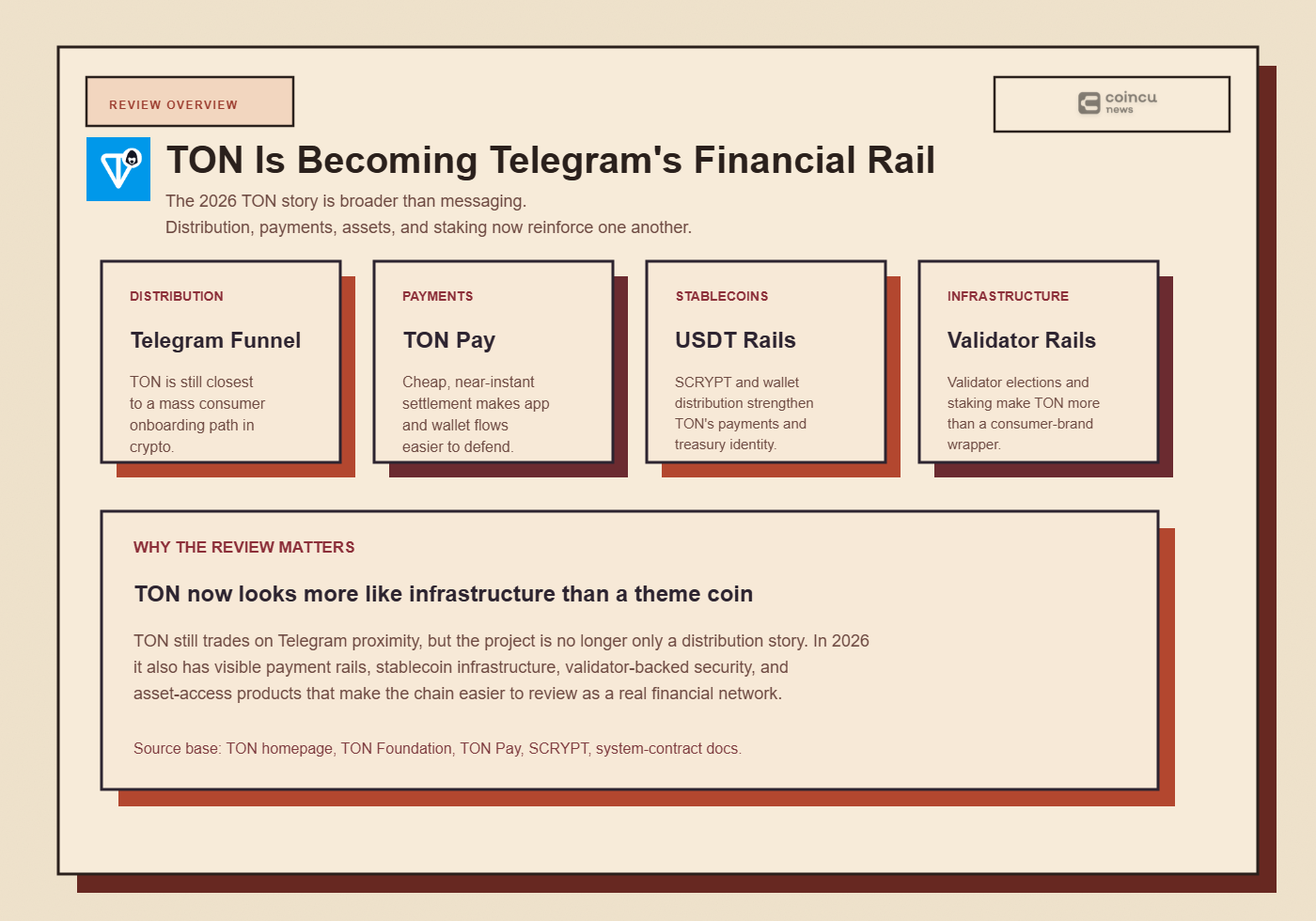
The network is now easier to frame through a specific stack: wallet access inside Telegram, fast settlement after Catchain 2.0, stablecoin rails through USDT and SCRYPT, payment infrastructure through TON Pay, and tokenized-asset access through xStocks.
That package lands far better than the old shorthand of “Telegram coin.” For market participants looking at the bigger setup, Coincu’s explainers on types of stablecoins, real-world assets in crypto, and proof of stake help frame where TON now sits.
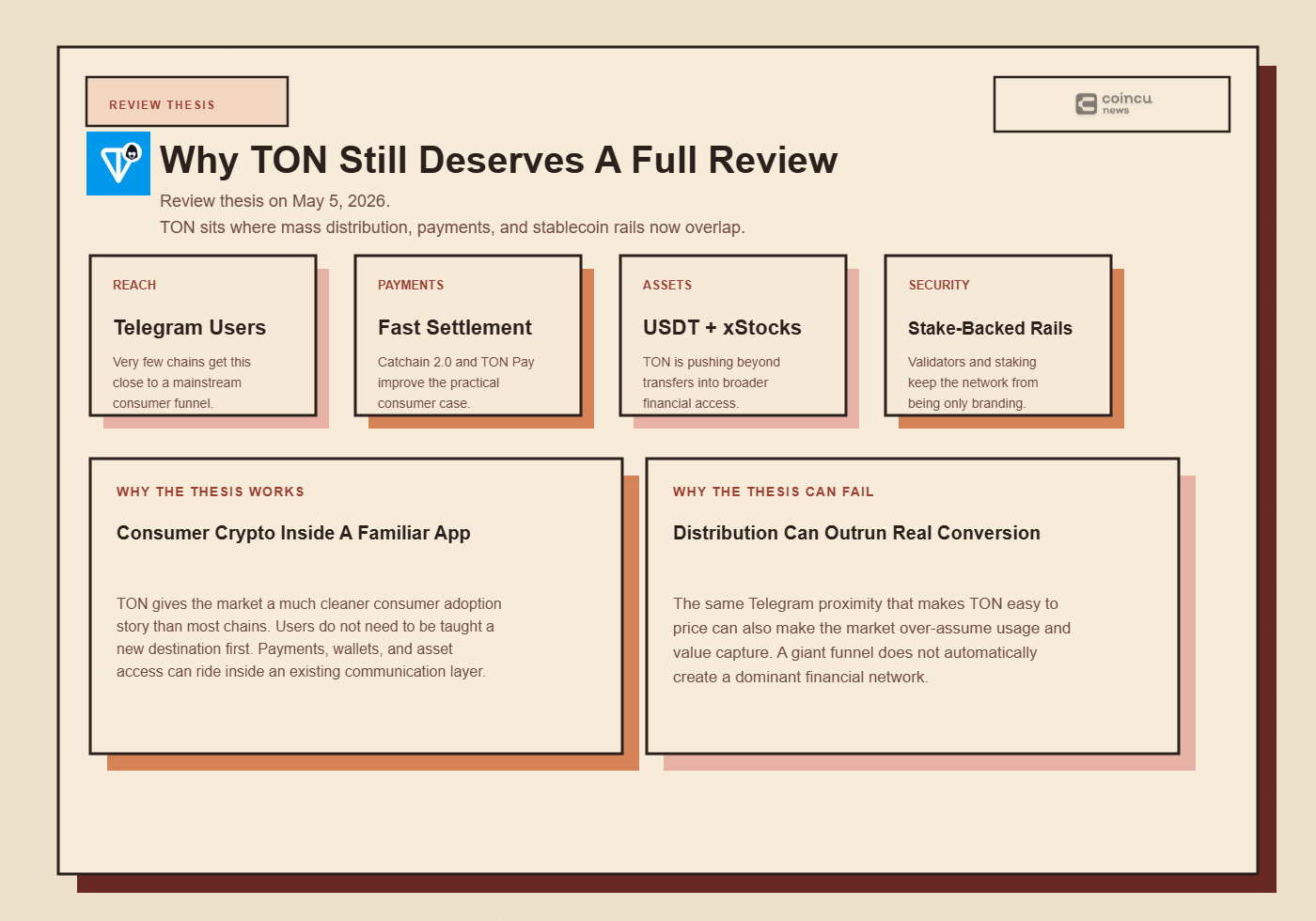
TON deserves a serious review because it already has real infrastructure, real market depth, and a credible consumer-finance direction. It also still depends heavily on Telegram proximity, product execution, and continued conversion of narrative into measurable network usage.
This review has been fully updated for 2026 to replace older TON review framing with the network’s current structure, product rails, and risk profile.
Key Takeaways
- Toncoin is best understood as the native asset of a Telegram-linked consumer blockchain, not as a generic Layer 1 competing only on abstract technical specs.
- TON’s strongest edge is distribution. The official TON site says builders can reach more than 1 billion Telegram users, while the network homepage also highlights more than 100 million wallet users across the ecosystem.
- The project story in 2026 is broader than messaging. TON Pay, institutional USDT access through SCRYPT, xStocks, and sub-second finality all push the chain toward a more practical financial-rail identity.
- TON governance is more structured than many casual market takes assume. Validator elections, staking, and configuration changes are handled through on-chain system contracts rather than informal off-chain coordination alone.
What Is Toncoin?
Toncoin is the native asset of The Open Network, an open-source proof-of-stake blockchain that grew out of Telegram’s original TON codebase but is now maintained by an independent community and supported by TON Foundation. The CoinMarketCap Toncoin page still summarizes that lineage clearly: Telegram’s original involvement ended in 2020, after which the network continued as an independent project with Toncoin as its native asset.
TON is often misread from both directions. Part of the market still treats it as a Telegram-owned chain, which is too simplistic. Another part treats the Telegram link as mostly branding residue, which is also too simplistic. In practice, TON sits in a middle ground. It is not Telegram’s internal chain in the corporate sense, but its product direction, distribution logic, and adoption case remain deeply tied to Telegram’s ecosystem.
The official TON homepage makes that strategy explicit. It says TON lets builders reach more than 1 billion Telegram users with instant onboarding and open on-chain infrastructure. That positioning is one of the clearest explanations of what TON is trying to become: a blockchain that feels less like a separate destination and more like the financial and application layer under a consumer platform people already use.
The project therefore reads through four linked layers:
| Layer | What TON is trying to be | Why it matters |
|---|---|---|
| Distribution layer | A blockchain embedded where Telegram users already live | Reduces the user-acquisition friction most chains still face |
| Payments layer | A low-friction settlement rail for in-app transfers and commerce | Pushes Toncoin beyond simple holding and speculation |
| Asset-access layer | A chain where users can hold stablecoins, tokenized stocks, and other assets in one wallet flow | Expands the addressable use case beyond chat-linked utility |
| Infrastructure layer | A scalable proof-of-stake network with validator elections, on-chain governance contracts, and fast settlement | Makes the chain more than just a consumer-brand wrapper |
That is also why Coincu’s explainer on the crypto glossary is useful for newer market entrants coming to TON through a mainstream review page rather than a trading note. TON increasingly sits where payments, staking, asset-access, and consumer onboarding meet, so the conceptual overlap now carries more weight than the ticker alone.
How TON Actually Works
TON is not only selling a big audience. It is also selling a specific kind of blockchain architecture.
TON’s documentation describes the network as a scalable blockchain platform for smart contracts, applications, and payments at consumer scale. The system is built around validator participation, proof-of-stake economics, and network-level contracts that manage elections and protocol configuration.
The clearest official governance explanation appears in TON Docs on system contracts. Two parts matter most:
- The Elector smart contract manages validator elections, validation rounds, complaints, and reward distribution.
- The Config contract manages network configuration parameters, validator-set updates, and proposal voting.
The key point is that TON’s validator and configuration logic is not just a social process. Important functions sit inside auditable on-chain contracts. The same docs also show that validators apply through the Elector contract with stake, keys, and operational parameters, while reward distribution and frozen-stake handling are managed by the protocol itself.
TON’s current technical appeal also changed meaningfully in April 2026. In its official post on sub-second finality going live, TON said Catchain 2.0 reduced confirmation time to about one second and block intervals to roughly 400 milliseconds. The related TON docs page on sub-second finality says the mainnet block interval dropped from roughly 2.5 seconds to roughly 400 milliseconds, with target finalization lag moving from around 10 seconds to about 1 second.
That upgrade is not just a benchmark headline. It changes what consumer applications on TON can plausibly feel like. Payments, trading, and Telegram Mini App interactions become easier to defend when the chain no longer feels sluggish.
Who Runs TON Now?
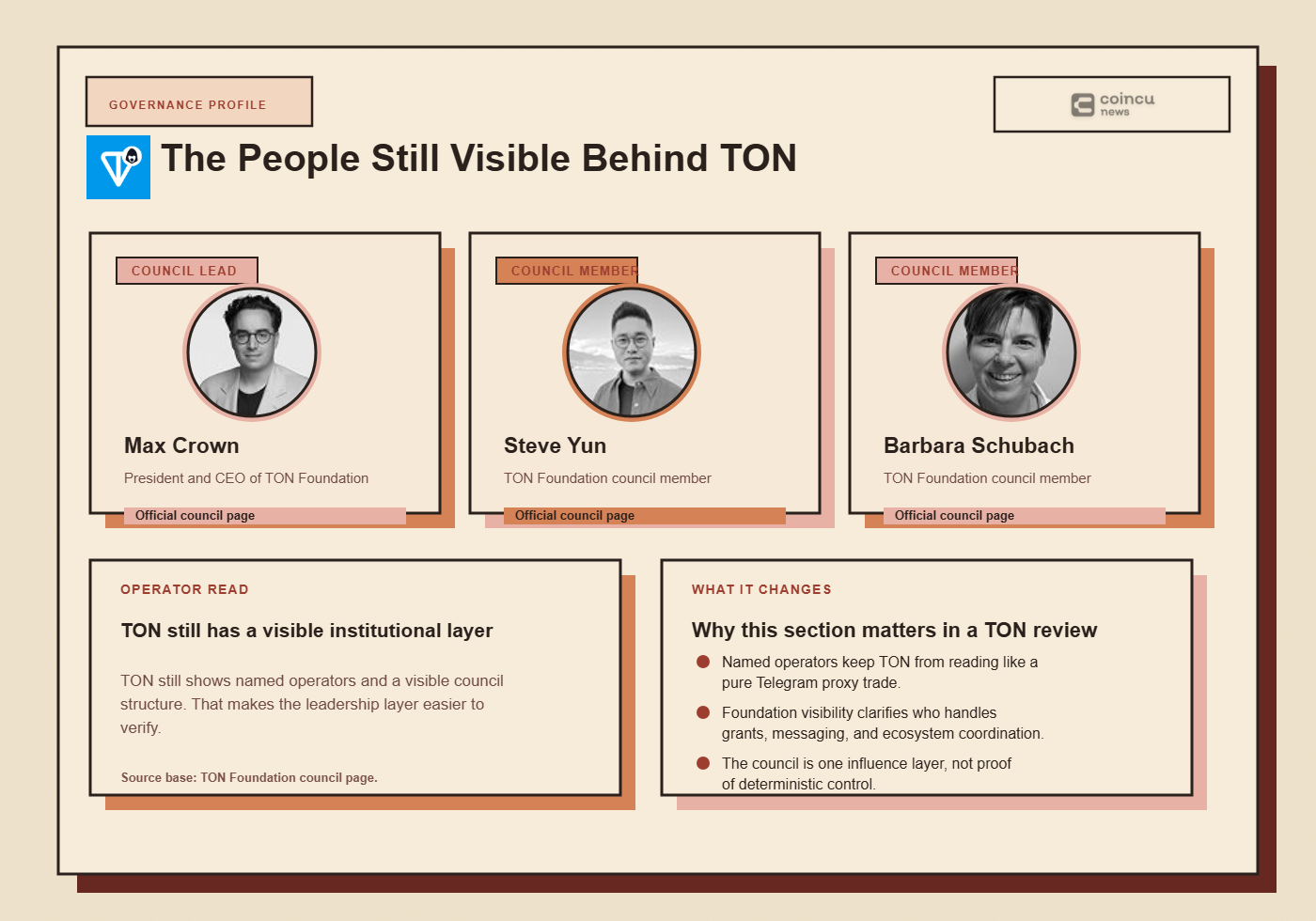
The official TON Foundation page says the Foundation Council is made up of TON community contributors and currently lists Max Crown as President of the Foundation Council and CEO of TON Foundation, alongside Steve Yun and Barbara Schübach as council members. Two points come through immediately.
The leadership timeline reinforces that hybrid structure. TON’s April 2025 announcement on appointing Maximilian Crown as CEO said TON’s “exclusive integration with Telegram” was a strategic differentiator. Then, in August 2025, TON Foundation announced that Max Crown had become both President and CEO, while Manuel Stotz stepped down from the presidency to focus on TON Strategy Co.
The cleanest way to read TON governance in 2026 is this:
| Governance layer | What it looks like today | Why it matters |
|---|---|---|
| Protocol rules | Elector and Config contracts manage elections, proposals, and validator updates | Core governance is systematized on-chain |
| Validator security | Stake-backed validator participation and reward distribution remain central | Network operation still depends on economic security |
| Foundation layer | TON Foundation provides leadership, grants, and ecosystem support | Public coordination still matters for growth |
| Telegram linkage | Telegram remains the main distribution partner and user funnel | Distribution influence is real even if protocol control is not identical |
That last row is the subtle one. Telegram influence and TON Foundation leadership clearly matter. But bonded-stake and validator-operations structure still matter too, and they are not the same thing as unilateral corporate control.
How TON Supply and Staking Work
The review case for TON becomes clearer once supply is separated into three different questions:
- how much is live
- how much is staked or locked in network-security rails
- whether that structure looks more like a usable network or a trapped-float trade
Using the CoinMarketCap Toncoin page checked for this review cycle, Toncoin’s circulating supply was about 2.49 billion TON against about 5.17 billion total supply, with a market cap around $3.31 billion and a fully diluted value around $6.85 billion. TON is clearly not a fully-live-supply asset. There is still a meaningful gap between circulating and total supply.
The more useful structural read comes from TonStat. The TonStat overview tracks validator stake, liquid staking, active wallets, DEX activity, and related network metrics. For this review cycle, TonStat showed about 844.89 million TON staked at the validator layer and about 98.42 million TON in liquid staking.
That combination weakens the most superficial market read. TON is not a small-cap low-float squeeze. It is a large network where a meaningful share of supply still sits in validator and yield-oriented rails instead of remaining purely available for immediate trading. For holders and traders looking at the structure behind that, Coincu’s liquidity pool explainer and tokenomics explainer are useful references.
The structure looks like this:
| Supply and staking clue | Point-in-time reading checked on May 5, 2026 |
|---|---|
| Circulating supply | 2.49B TON |
| Total supply | 5.17B TON |
| Market cap | $3.31B |
| FDV | $6.85B |
| Validator stake | 844.89M TON |
| Liquid staking | 98.42M TON |
| Validators | 370 |
This does not make TON scarce. It does make TON structurally different from many large-cap assets whose supply is more passively idle.
What the Network Actually Does Today
One reason TON deserves a fresh review in 2026 is that the product story is more concrete now than it was in 2024.
The official product stack now includes several practical rails:
| Product rail | Official source | Why it matters |
|---|---|---|
| TON Pay | TON Pay announcement | Shared payments backend for TON-based apps and Telegram-native commerce |
| Institutional stablecoin access | SCRYPT partnership | Makes USDT on TON easier to frame as treasury and payment infrastructure |
| Tokenized equities | xStocks on TON | Broadens the chain from payments into asset access |
| Telegram-native DeFi | 2025 in Review: DeFi on TON | Shows how swaps, yields, and stablecoins are being positioned inside Telegram UX |
| Wallet stack | TON site and wallet infrastructure update | Makes onboarding and wallet deployment easier for both users and developers |
These rails matter together more than separately.
The TON Pay page says transactions settle near-instantly at significantly lower cost than traditional methods and describes the product as a shared payments backend for TON applications. The SCRYPT partnership page goes even further, explicitly framing stablecoins as the settlement layer for payments, ecosystem distribution, and treasury operations.
And the xStocks launch article says tokenized U.S. equities can be traded directly inside TON-compatible wallets without separate brokerage workflows. That framing also fits neatly with Coincu’s broader coverage of Mastercard’s global stablecoin support push, because the market increasingly rewards chains that can connect payments, wallets, and on-chain dollars in one user flow.
This is why TON no longer reads like a chain that is only promising future optionality. A meaningful part of the product stack is already visible, even if adoption depth remains uneven.
Why TON Still Gets Attention
TON still gets attention because several structurally important ideas meet in one place.
The first is consumer distribution. The official TON homepage says builders can reach more than 1 billion Telegram users. Very few crypto ecosystems can make a distribution claim that large without sounding imaginary.
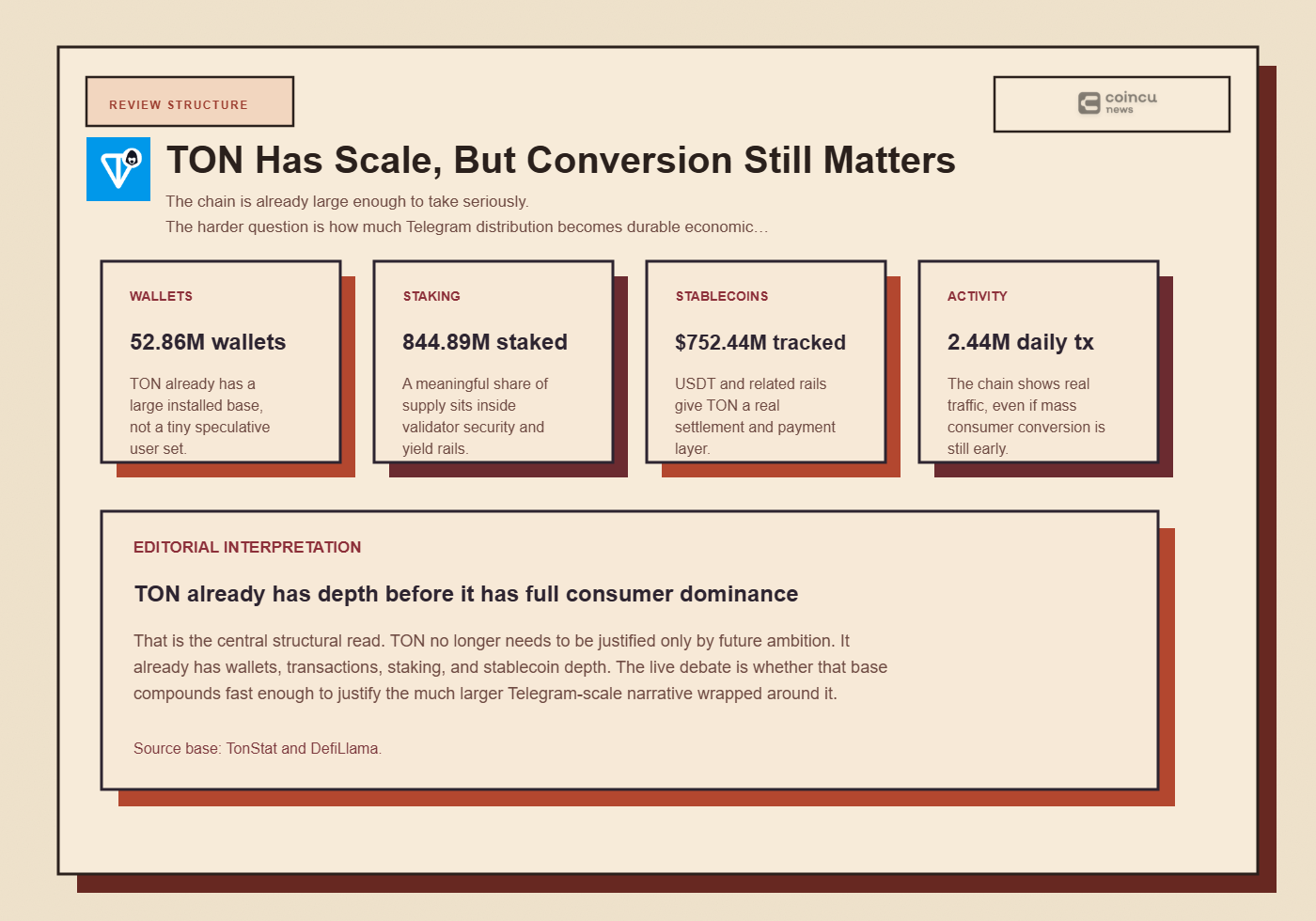
The second is real usage. TonStat’s latest visible readings for this review cycle show about 52.86 million wallets, about 97,642 daily active wallets, and about 2.44 million daily transactions. Those numbers do not prove explosive mass adoption, but they do prove the chain is not operating in a vacuum.
The third is asset and payment breadth. According to the SCRYPT announcement, TON now supports more than 50 million wallets and is pushing deeper into institutional stablecoin access. According to the TON site, the ecosystem also emphasizes staking, payments, wallets, domains, digital collectibles, and apps running directly through Telegram-adjacent flows.
The fourth is that DeFi inside Telegram has become easier to explain. In its 2025 DeFi review, TON Foundation argued that swaps, yields, and collateral usage on TON were becoming more reliable and more embedded in familiar user experience rather than forcing users into separate, specialist interfaces. Anyone comparing TON with the wider market can also use Coincu’s coverage of Toncoin landing on Robinhood as users and TVL climbed as a reminder that exchange access and distribution optics have been helping the TON narrative for a while, not just this year.
The fifth is that the chain still carries a large narrative premium, but not an empty one. TON has enough working rails and enough usage to keep the story from collapsing into pure brand mythology.
Main Risks of Holding or Trading TON
The first risk is still Telegram dependence. TON’s biggest strategic edge is also its biggest structural concentration risk. If Telegram distribution slows, changes direction, or fails to convert at the expected pace, part of the TON premium can unwind.
The second risk is that narrative can outrun conversion. A chain sitting in front of 1 billion users is not the same as a chain monetizing even a small percentage of them effectively. TON’s addressable market is huge. Actual active-wallet conversion remains much smaller.
The third risk is that product breadth can create analytical laziness. When a chain touches payments, DeFi, stablecoins, RWAs, and wallets at once, the market can start treating category overlap as if it were proven economic dominance.
The fourth risk is supply and valuation overhang. TON is not a fully live-supply asset, and the gap between market cap and FDV still matters. It is harder to dismiss than in 2024, but it has not disappeared.
The fifth risk is governance interpretation. TON is not simply centralized, but leadership visibility, Foundation coordination, and Telegram proximity mean the market should not confuse “open-source” with “uninfluenced by major ecosystem actors.”
| Structural risk | Why it matters |
|---|---|
| Telegram dependence | TON’s strongest moat still depends on one dominant distribution environment |
| Conversion risk | A giant funnel does not guarantee active on-chain economic behavior |
| Narrative overpricing | Payments, DeFi, and asset-access stories can be priced faster than they compound |
| Supply overhang | Circulating supply is still well below total supply |
| Governance interpretation risk | Influence is more layered than simple decentralization marketing suggests |
Why TON Matters in 2026
TON matters in 2026 because it may be the clearest live test of whether a blockchain can become normal consumer infrastructure inside a large communication platform instead of remaining a specialist crypto environment.
The chain is still early relative to the size of that ambition, but it is no longer early in the weak sense of “mostly a promise.” It now has visible payment rails, validator and governance infrastructure, real wallet scale, stablecoin and asset-access products, and a credible claim to consumer distribution most chains cannot match.
That does not make TON the default winner. It does make TON one of the few large-cap crypto networks whose strategic question is not only “can the tech scale?” but “can crypto become ordinary inside a mass consumer interface?” That is a much more important review question than price alone.
Current TON Snapshot
Last updated: May 5, 2026
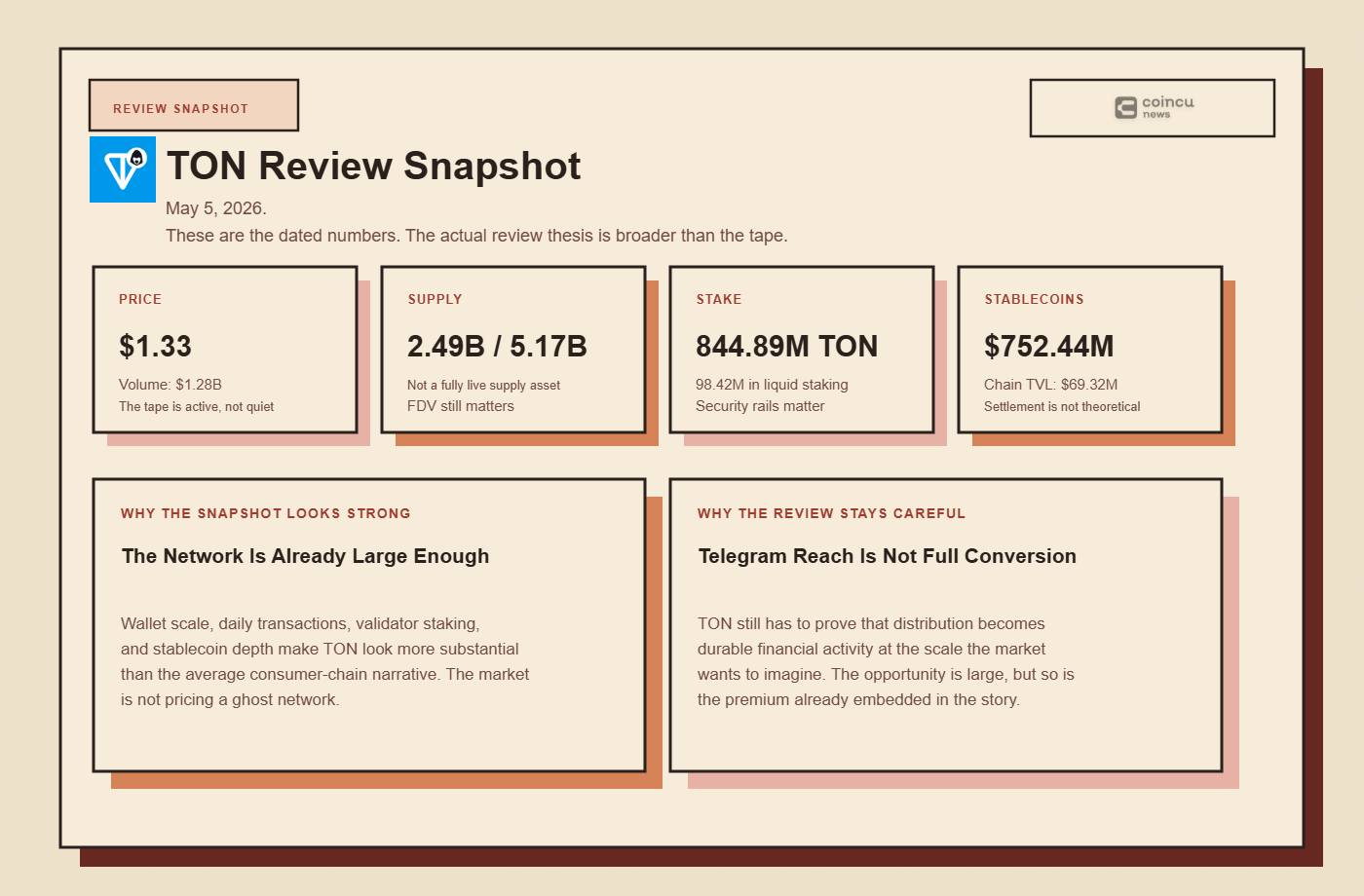
The sections above are designed to stay useful as a structural review. The figures below are the point-in-time snapshot checked for this review cycle.
| Metric | Value |
|---|---|
| Price | $1.33 |
| 24h volume | $1.28B |
| Market cap | $3.31B |
| FDV | $6.85B |
| Circulating supply | 2.49B TON |
| Total supply | 5.17B TON |
| Wallets | 52.86M |
| Daily active wallets | 97,642 |
| Daily transactions | 2.44M |
| Validators | 370 |
| Validator stake | 844.89M TON |
| Liquid staking | 98.42M TON |
| Chain TVL | $69.32M |
| Tracked stablecoins | $752.44M |
These numbers help anchor the review, but they should not be mistaken for the review itself. The review is about TON’s structure, positioning, and risk profile. The snapshot is just the latest visible measurement of that structure.
FAQ - The Open Network Review 2026
What is Toncoin used for in 2026?
Toncoin is used as the native asset for fees, staking, validator participation, wallet transfers, and activity across TON’s broader ecosystem. In practice, the project story now also includes payments, stablecoins, Telegram Mini App flows, and tokenized-asset access.
Is Toncoin still just a Telegram coin?
No. Telegram remains TON’s main distribution moat, but the 2026 review case is broader than branding. TON now has visible payment rails, institutional stablecoin access, tokenized equities, validator economics, and a maturing DeFi layer.
Is TON decentralized?
It is more decentralized than the simplest “Telegram chain” label suggests, but not so diffuse that leadership and ecosystem influence become irrelevant. TON uses validator elections, staking, and on-chain system contracts, while TON Foundation still plays a visible coordination role.
What is the biggest strength of TON in 2026?
Distribution. TON is positioned where wallets, payments, apps, and asset access can live inside Telegram’s existing user environment.
Is Toncoin a good investment in 2026?
The honest review answer is conditional. TON looks stronger than many narrative-led chains because it already has real wallets, transactions, staking depth, and visible product rails. But whether it becomes a good investment from here depends on whether Telegram-scale reach turns into stronger economic conversion and value capture rather than just a persistent narrative premium.
What is the biggest risk in the TON thesis?
The largest risk is that Telegram proximity and product breadth get priced faster than active usage, fee capture, and deeper economic conversion actually grow.
Does TON already have real on-chain usage?
Yes. TonStat still shows a large installed base and meaningful daily activity, even if the chain is not converting Telegram-scale distribution into mass daily financial activity yet.
What makes TON different from other Layer 1s?
The main difference is where adoption is supposed to happen. Most Layer 1s still need to pull users into separate crypto-native destinations. TON is trying to let wallets, payments, and asset access grow inside a communication platform users already know.
Methodology
This review is based on public materials checked on May 5, 2026, including the CoinMarketCap Toncoin page, the official TON homepage, the TON Foundation page, TON Docs on system contracts, TON Docs on sub-second finality, the official posts on Catchain 2.0, TON Pay, SCRYPT, xStocks, TON Foundation leadership, Max Crown becoming President and CEO, 2025 in Review: DeFi on TON, TonStat, and DefiLlama’s TON chain page.
The core body is written as a structural review first. Time-sensitive market and network data are isolated in the snapshot section so the page can be updated later without rewriting the full thesis.
Disclaimer
This article is for research and informational purposes only and should not be treated as financial advice. Toncoin is a large-cap asset with real infrastructure and real usage, but large narratives can still outrun measurable economic conversion, governance clarity, and market fundamentals.
SourcesCoinMarketCap, Toncoin page: https://coinmarketcap.com/currencies/toncoin/
TON homepage: https://ton.org/en
TON Foundation page: https://ton.org/en/ton-foundation
TON Docs, system contracts: https://docs.ton.org/foundations/system
TON Docs, sub-second finality: https://docs.ton.org/ecosystem/subsecond
TON, TON Is Now Up to 6x Faster: Sub-Second Finality Is Live: https://ton.org/ach/Ton_is_now_up_to_6x_faster
TON, TON Pay: A New Payments Layer for TON: https://ton.org/ton-pay-a-new-payments-layer
TON, TON Partners with SCRYPT to Enable Institutional Access to Stablecoins: https://ton.org/ton_partners_with_scrypt
TON Foundation, xStocks Are Live on TON: Real-World Stocks, Now On-Chain: https://blog.ton.org/x-stocks-are-live-on-ton-real-world-stocks-now-on-chain
TON Foundation appoints Maximilian Crown as CEO: https://ton.org/en/ton-foundation-appoints-maximilian-crown-ceo
Max Crown Appointed President and CEO of TON Foundation: https://blog.ton.org/max-crown-appointed-president-and-ceo-of-ton-foundation
TON Foundation, 2025 in Review: DeFi on TON: https://blog.ton.org/defi-on-ton
TON Foundation, The Agent Economy Has a Billion-User Head Start. It’s Called Telegram.: https://www.ton.org/en/the_agent_economy_inside_telegram
TonStat: https://www.tonstat.com/
DefiLlama, TON chain page: https://defillama.com/chain/TON?tvl=true
Security audits, TON Docs: https://docs.ton.org/v3/concepts/security-measures
The post The Open Network Review 2026: Can TON Turn Telegram Into A Real Financial Rail? was initially published on Coincu.
