



Trump says Hormuz reopening 'not tied to Lebanon'
 $TRUTH
 DJT
DJT
 TRUMP
TRUMP
 DON
DON
 TRUMP2024
A diplomatic breakthrough in the Middle East sent shockwaves through global markets on April 17, easing one of the biggest risks hanging over investors since fighting erupted earlier this year.
Iran’s decision to reopen the Strait of Hormuz and begin clearing sea mines added to hopes that global energy flows could soon normalize.
After weeks of supply fears, military escalation and failed negotiations, traders suddenly began pricing in the possibility that the worst of the crisis may be passing.
The shift came after Washington claimed progress toward a broader settlement.
"THE STRAIT OF HORMUZ IS COMPLETELY OPEN AND READY FOR BUSINESS AND FULL PASSAGE," U.S President Donald Trump announced on Truth Social on April 17.
Related: Energy chief warns Europe only has six weeks of fuel left
US blockade pressure mounted as Trump pushed for final deal
The Strait of Hormuz, which carries roughly one-fifth of global oil flows, had seen traffic severely disrupted since the U.S.-Israeli campaign against Iran began on Feb. 28.
In April, Washington imposed a naval blockade targeting Iranian ports, saying vessels entering or leaving Iran’s coastline could be intercepted or turned back.
The measure was intended to restrict Tehran’s oil revenues and pressure negotiators after talks in Pakistan failed earlier this month.
Following this and leading up to the opening of Strait of Hormuz, Trump on April 16 announced a 10-day ceasefire between Israel and Lebanon to allow room for further negotiations.
Trump had further signaled that the conflict could soon be resolved after helping secure the Lebanon truce.
“We’re going to see what happens. But I think we’re very close to making a deal with Iran,” Trump told reporters.
He also invited Israeli Prime Minister Benjamin Netanyahu and Lebanese President Joseph Aoun to the White House for follow-up peace talks.
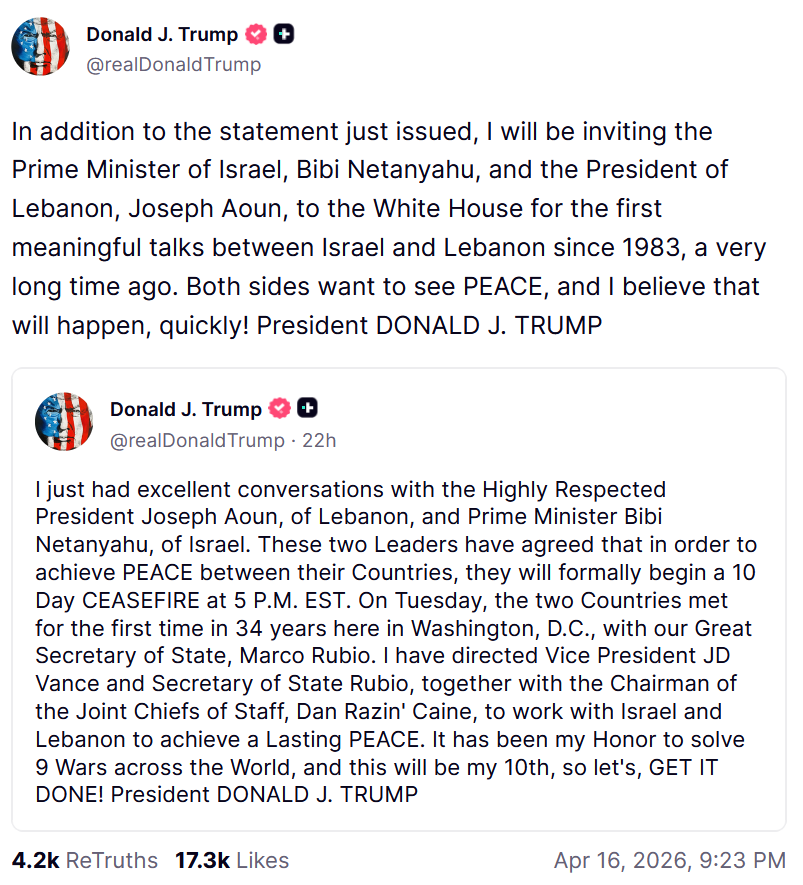
The remarks helped fuel expectations that the shipping disruption could end sooner than markets had feared.
Iran had demanded a ceasefire in Lebanon as part of broader de-escalation efforts, with Reuters reporting on March 26 that Tehran wanted any wider agreement with the United States and Israel to also halt attacks on Hezbollah in Lebanon.
Related: Nasdaq, S&P 500 gain after Trump secures 10-day Israel-Lebanon ceasefire
Iran declares Hormuz open after Lebanon ceasefire takes effect
Hours after the 10-day ceasefire between Israel and Lebanon began on April 16, Iranian Foreign Minister Abbas Araghchi said commercial transit through Hormuz would resume.
“In line with the ceasefire in Lebanon, the passage for all commercial vessels through Strait of Hormuz is declared completely open for the remaining period of ceasefire,” Araghchi wrote.
The Lebanon truce had been a key Iranian demand in wider negotiations, raising hopes that direct U.S.-Iran talks could restart in the coming days.
Getty Images
Shipping markets had been watching for any signal that mines, military patrols or blockade measures would be rolled back enough to allow normal traffic through the narrow waterway.
Most Popular on TheStreet Roundtable:
- JPMorgan has stark message for investors on market weakness
- New report reveals nearly 40% of Americans have less than $500 in savings
- Wall Street legend's firm reports $3.8 billion in quarterly loss
In a later post on Truth Social, Trump said Iran had begun clearing maritime explosives from the waterway, suggesting commercial shipping routes were being restored faster than expected.
“Iran, with the help of the U.S.A., has removed, or is removing, all sea mines! Thank you!” Trump wrote on Apr. 17.
Trump also added that the emerging agreement was separate from the Lebanon ceasefire, while reiterating support for regional diplomacy.
“Again! This deal is not tied, in any way, to Lebanon, but we will, MAKE LEBANON GREAT AGAIN!” he wrote.
Trump claims Iran has agreed to never close the Strait of Hormuz again, saying it will “no longer be used as a weapon against the world”
Oil plunges as Bitcoin, XRP rebound
Crude prices fell sharply after Iran’s announcement, with benchmark oil sliding to $82.21 per barrel at press time, down $ 12.47 or 13.18% on the day, after surging during the conflict.
The decline reflected expectations that Gulf exports may normalize and emergency supply risks could ease.
Crypto markets also rallied as traders rotated back into risk assets.
Crypto markets also rallied as traders rotated back into risk assets.
Bitcoin rose to $77,758 on April 17, its highest level in roughly 10 months, while XRP climbed to $1.49 after recent war-driven volatility. Ethereum, Solana and BNB also posted solid gains as market sentiment improved.
Related: Citigroup has blunt take on portfolio returns in 10 years
