Key Takeaways Agencies clash over reserve management control. U.S. holds 328,372 BTC national stockpile. No taxpayer funds financing reserve purchases. Indefinite holding replaces historical
Key Takeaways
- Agencies clash over reserve management control.
- U.S. holds 328,372 BTC national stockpile.
- No taxpayer funds financing reserve purchases.
- Indefinite holding replaces historical liquidation mandates.
- DOJ evaluating legal framework for volatility.
- Congressional legislation essential for full expansion.
The Trump administration’s ambitious plan to establish a Strategic Bitcoin Reserve has entered a phase of intense administrative friction. According to a recent Bloomberg report, the initiative, launched via Executive Order 14233 in March 2025, is currently complicated by an internal competition between the U.S. Department of the Treasury and the Department of Commerce for regulatory custody of the nation’s digital assets. This bureaucratic gridlock has effectively moved the reserve from a high-profile “on-paper” concept into a complex phase of structural and legal design.
Sovereign Holdings and the “No-Sell” Mandate
The U.S. government currently ranks as the world’s largest sovereign Bitcoin holder, controlling approximately 328,352 BTC, an accumulation verified by on-chain data from Arkham Intelligence. These assets, valued at over $21.526 billion, are primarily derived from various criminal and civil forfeitures. Under the administration’s new “no-sell” directive, the White House intends to end the historical practice of liquidating seized cryptocurrency, which officials estimate has cost taxpayers roughly $17 billion in lost appreciation over the past decade.
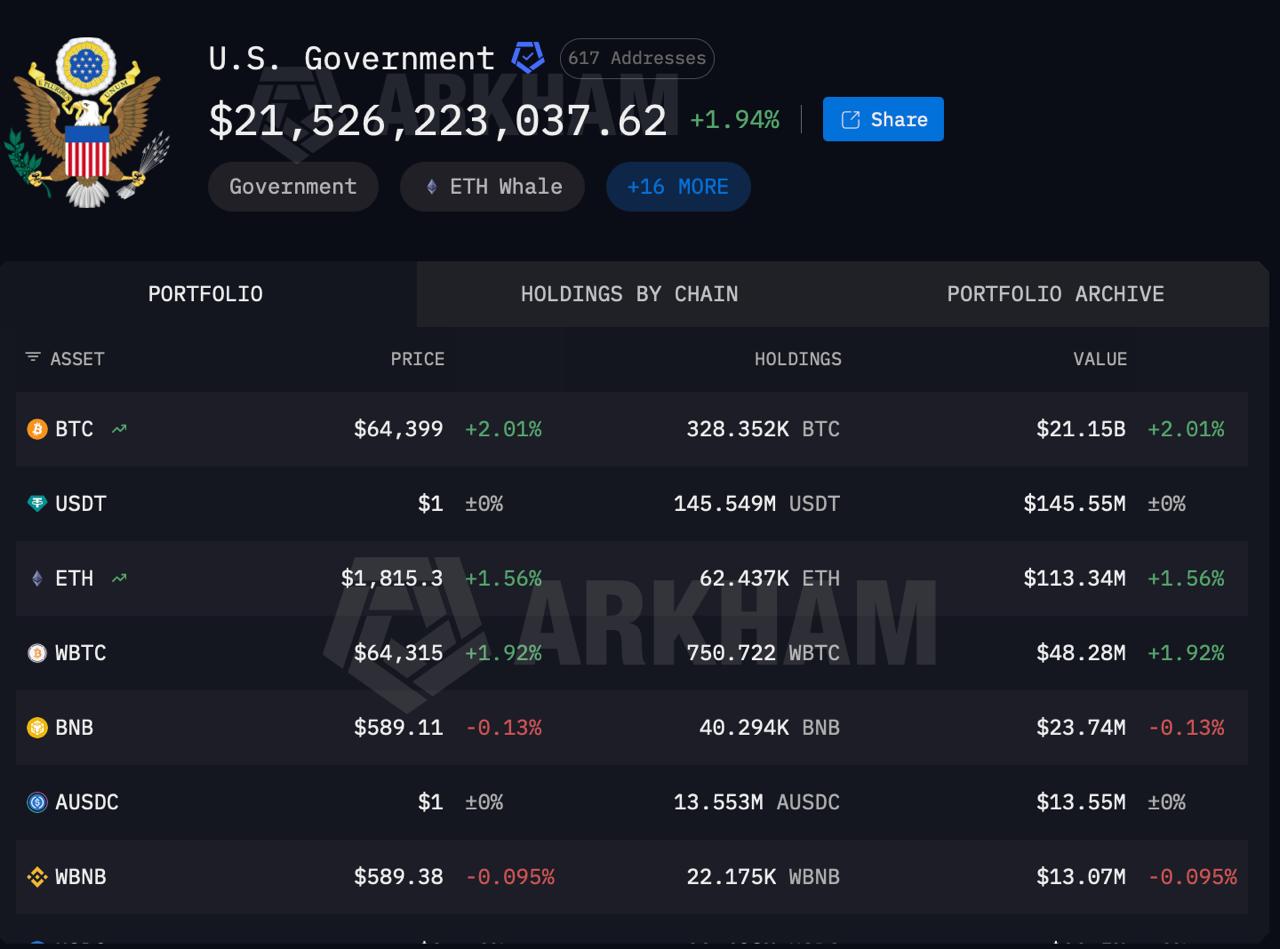
Arkham Intelligence dashboard displaying the U.S. Government’s current digital asset portfolio breakdown.
The reserve is strictly “budget-neutral.” Current executive mandates prohibit the use of taxpayer funds for market acquisitions, meaning the reserve currently grows only through federal seizures. While the Treasury and Commerce departments are tasked with exploring “budget-neutral” strategies to acquire additional Bitcoin, potentially through trading other government assets, no open-market purchasing has commenced to date.
The Jurisdictional and Legal Impasse
The current operational delay stems from two significant hurdles:
- Departmental Turf War: While the Treasury Department was the original intended home for the reserve, concerns regarding its legal capacity to manage such a volatile asset have invited the Commerce Department to vie for control, leading to a standstill in management oversight.
- DOJ Legal Review: The Department of Justice’s Office of Legal Counsel is currently assessing whether federal agencies possess the statutory authority to hold highly volatile digital assets indefinitely, rather than adhering to traditional asset forfeiture rules that prioritize prompt liquidation.
READ MORE:
 Clarity Act: Major Law Enforcement Shift Paves Way for July Vote
The Role of the American Reserve Modernization Act (ARMA)
For investors and policy observers, the focus is shifting toward the legislative landscape. The proposed American Reserve Modernization Act (ARMA), often referred to as “Version 2” of the BITCOIN Act, is the primary vehicle for stabilizing the reserve. As industry analysts and congressional sponsors point out, the reserve requires more than an executive order; it requires the weight of law to survive political cycles.
ARMA aims to consolidate custody under the Treasury, mandate a 20-year minimum holding period, and introduce transparency measures such as quarterly “Proof of Reserve” reports and independent third-party audits. By establishing these guardrails, the legislation seeks to move the reserve beyond the current jurisdictional disputes, potentially allowing the government to acquire up to 1 million BTC over five years without increasing the national deficit.
A Work in Progress
As of July 2026, the Strategic Bitcoin Reserve remains a strategic intent supported by executive order rather than a fully realized national financial institution. The administration maintains its goal of cementing America as the “crypto capital of the world,” but market participants should view the current status as a “managed anticipation” phase.
The formalization of the reserve, contingent on resolving inter-agency friction and securing statutory approval for ARMA, represents a monumental shift toward treating Bitcoin as a sovereign-grade asset. Until the jurisdictional and legislative elements are finalized, the reserve will continue to operate under its current “seizure-only” model, awaiting the clarity that only full congressional passage can provide.
This article is for informational purposes only and does not constitute financial or legal advice. Consult a professional before making investment decisions.The post US Bitcoin Reserve Plan: Key Obstacles Blocking Progress in 2026 appeared first on Coindoo.