Kishu Inu has a long public history across websites, social accounts, token trackers, NFT collections, GitHub repositories, archived files, and older community posts. Some of that information
Kishu Inu has a long public history across websites, social accounts, token trackers, NFT collections, GitHub repositories, archived files, and older community posts. Some of that information is still easy to find. Some of it is scattered. Some older claims need to be checked against public records before they are treated as current.
The current Kishu Community archive and rebuild effort is focused on organizing that public record in a safer and more transparent way.
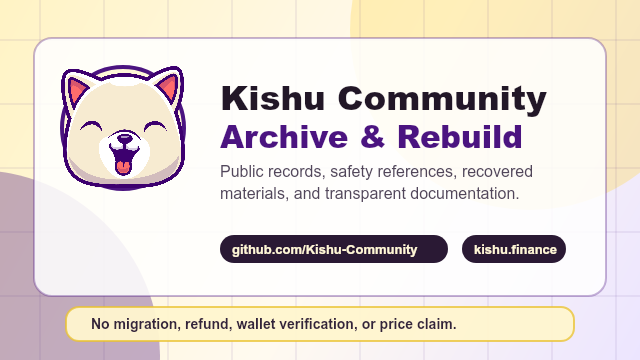
This is not a migration announcement, refund claim, wallet verification process, airdrop, investment recommendation, or price prediction. It is a public update about where current community documentation is being organized and how people can verify information before trusting links or wallet prompts.
The main public workspace is the Kishu-Community GitHub organization:
https://github.com/Kishu-Community
The current rebuild homepage is:
https://kishu.finance
The current community Telegram for this GitHub/archive effort is:
https://t.me/KishuCommunityGithub
The public social media post archive is:
https://github.com/Kishu-Community/social-media-posts
GitHub is being used because it gives the community a place to review longer notes, recovered materials, safety references, public post drafts, and project-status documentation without relying only on social media platforms.
Original KISHU Contract Reference
The original KISHU Ethereum token contract is:
0xa2b4c0af19cc16a6cfacce81f192b024d625817d
Etherscan reference:
https://etherscan.io/token/0xa2b4c0af19cc16a6cfacce81f192b024d625817d
Anyone reviewing KISHU-related links should verify the contract directly on Etherscan before connecting a wallet, approving a swap, or trusting a token page.
What This Community Effort Can And Cannot Do
This archive/rebuild effort does not control the original KISHU token contract, legacy deployer wallets, owner Safe, NFT collection owner wallets, or former team accounts.
Because of that, there are limits to what can be changed safely. Without verified authority over the original contracts and wallets, this effort cannot:
- Change the original KISHU token contract.
- Control the original owner Safe.
- Move, repair, or upgrade legacy staking contracts.
- Force a migration.
- Update old NFT contracts or collection ownership.
- Claim to be the official continuation of the original project.
- Promise that historical losses will be recovered or made whole.
Those limits are important for community safety. If someone claims there is an active migration, refund, recovery claim, wallet verification, or airdrop, treat it as suspicious unless it is documented through the Kishu-Community GitHub organization and verifiable from public sources.
This community effort will never ask for a seed phrase, private key, recovery phrase, wallet file, remote desktop session, or payment to "verify" a wallet.
What Is Being Organized
The current work is focused on public documentation and transparent cleanup.
That includes:
- Preserving recovered public materials.
- Publishing safety-first buying and contract reference guides.
- Keeping current links visible.
- Mapping known websites, repositories, contracts, deployments, wallets, and NFT collections where public information is available.
- Separating historical claims from current, verifiable systems.
- Marking older ecosystem items as historical, abandoned, incomplete, or unverified unless there is current evidence that they are maintained.
The goal is to make it easier for community members to understand what exists today, what was promised historically, what was actually deployed, what is broken or missing, and what would need to be rebuilt correctly.
Why Public Documentation Matters
Older crypto projects can become difficult to understand when important information only exists in old chats, social posts, inactive accounts, or private explanations.
Public documentation helps reduce confusion. It also makes it harder for anyone to create fake official links, fake recovery forms, fake migrations, fake support accounts, or fake wallet verification flows.
A GitHub-based archive does not solve every problem, but it creates a public trail that people can inspect. Community members can see what was added, what changed, and which references are connected to the current archive/rebuild work.
How To Use The Current References
If you are checking KISHU information, start with:
https://github.com/Kishu-Community
For current public post archives:
https://github.com/Kishu-Community/social-media-posts
For the current homepage:
https://kishu.finance
For the current community Telegram:
https://t.me/KishuCommunityGithub
For the original KISHU token contract:
https://etherscan.io/token/0xa2b4c0af19cc16a6cfacce81f192b024d625817d
Compare any KISHU-related claim against public references before connecting a wallet or signing anything.
Closing
The Kishu Community archive and rebuild work is about preserving the record, reducing confusion, and making current information easier to verify.
This is not a price post. It is not financial advice. It is not a migration, refund, recovery claim, wallet verification process, or airdrop.
Use official links. Verify contracts. Do not share wallet secrets. Treat recovery or migration claims with caution unless they are documented and verifiable from public sources.
Trust should be earned in public.