Quick answer Funding a crypto card usually requires holding a specific asset on a specific network — for Sparq, that means USDT on TRC20, BEP20, or ERC20. If the assets you hold don't match,
Quick answer
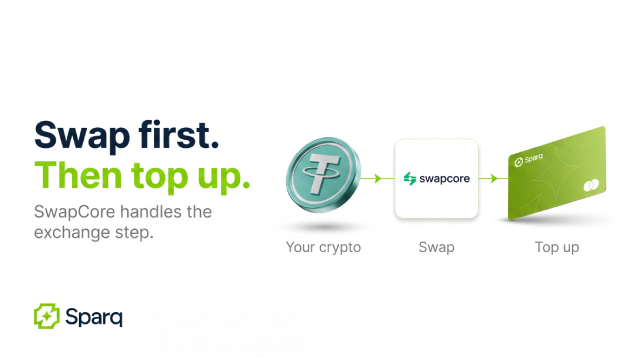
Funding a crypto card usually requires holding a specific asset on a specific network — for Sparq, that means USDT on TRC20, BEP20, or ERC20. If the assets you hold don't match, you need a swap first. Routing that swap through a KYC-required exchange reintroduces the verification step a no-KYC card was chosen to avoid. SwapCore is a no-KYC, no-account crypto-to-crypto exchanger, which keeps the whole chain consistent — and its fixed-rate option gives certainty on exactly how much lands on the card.
Table of contents
- The step most people skip over
- Why the KYC gap matters
- Fixed versus floating rates when funding a card
- No account means no custody
- Matching the network to the card
- FAQ
The step most people skip over
Most discussion of crypto cards focuses on the card. The step before it gets far less attention and causes more friction.
A crypto card is funded from specific assets on specific networks. Sparq supports BTC, ETH, and USDT, with top-ups over TRC20, BEP20, and ERC20. If you hold something else — an altcoin from a swap, a token received as payment, a different chain entirely — you need to convert before you can fund anything.
That conversion is where most of the cost and most of the friction lives, and it is usually treated as an afterthought rather than a decision.
Why the KYC gap matters
Sparq issues cards without KYC: no document upload, no verification queue, no waiting on approval before you can spend. For many users that is the primary reason to choose it.
The gap opens at the swap step. If the conversion runs through a platform that requires identity verification and account registration, the verification requirement has simply moved one step upstream. The card asked for nothing; the exchange asked for everything. The practical outcome is the same as using a verified card, with an extra platform involved.
SwapCore operates without KYC and without account registration. Combined with Sparq, the chain holds its property end to end: convert without verification, fund without verification, spend without verification.
This is a data-minimisation argument, not a compliance-avoidance one. Users remain responsible for their own tax and legal obligations in their jurisdiction regardless of which platforms they use. What changes is how many parties hold a copy of their identity documents — which, in a period where platform data breaches are routine, is a reasonable thing to want to minimise.
Fixed versus floating rates when funding a card
This distinction matters more for card top-ups than for general trading, and it is worth understanding before choosing either.
A floating rate settles at whatever the market gives when the transaction executes. It can be better than the quoted rate, and it can be worse.
A fixed rate locks the quote at the point of the exchange. You know exactly what arrives.
When the goal is funding a card with a specific amount — covering a subscription, loading a spending limit, topping up before a purchase — certainty is usually worth more than the chance of a marginally better rate. A shortfall on a card top-up means a declined transaction, which is a worse outcome than a slightly suboptimal rate.
SwapCore offers both, which makes the choice situational rather than fixed by the platform: fixed when the destination amount matters, floating when it doesn't.
No account means no custody
A no-account exchanger has a structural property beyond convenience: there is no balance sitting on the platform.
Account-based exchanges hold user funds between deposit and withdrawal. That creates custody exposure — the standard risk that has produced most of the industry's well-known failures.
A swap that executes without an account has no such window. Funds move through rather than sitting in. This aligns with Sparq's own non-custodial architecture, and it means neither step in the chain introduces a custodial holding period.
Matching the network to the card
One practical detail that saves both money and time: convert directly to the network you intend to use.
Sparq supports USDT on TRC20, BEP20, and ERC20. Converting to the correct network in a single step avoids a bridge afterward, which typically costs roughly 0.15% to 0.6% plus a wait of 5 to 45 minutes. That cost appears in no card fee schedule, because it occurs before the card is involved — but it recurs on every top-up where the network doesn't match.
Fees and confirmation times differ across the three networks and change with congestion, so the correct choice varies by transaction rather than being fixed. The advantage is having all three available on both sides of the chain.
For businesses, SwapCore additionally offers an API, a widget, and an affiliate programme, which allows the conversion step to be embedded rather than performed manually.
FAQ
Why not just buy USDT directly?Many routes to buying stablecoins with fiat require verification. If you already hold crypto, a crypto-to-crypto swap avoids that step entirely. SwapCore is crypto-to-crypto only.
Does no KYC mean the service is unregulated or anonymous?No. It means the platform does not require identity documents to perform a swap. Blockchain transactions remain publicly recorded, and users remain responsible for their own tax and legal obligations.
Should I choose a fixed or floating rate?Fixed when the amount arriving matters — such as funding a card to cover a specific charge. Floating when you are converting a balance without a target amount and are comfortable with variance.
Which network should I convert to?Whichever of TRC20, BEP20, or ERC20 has favourable fees and confirmation times at that moment. The point is converting directly to a network the card supports, avoiding a bridge afterward.
What happens if I convert to an unsupported network?You will need to bridge before funding, adding cost and delay. Confirming the destination network before executing the swap avoids this entirely.