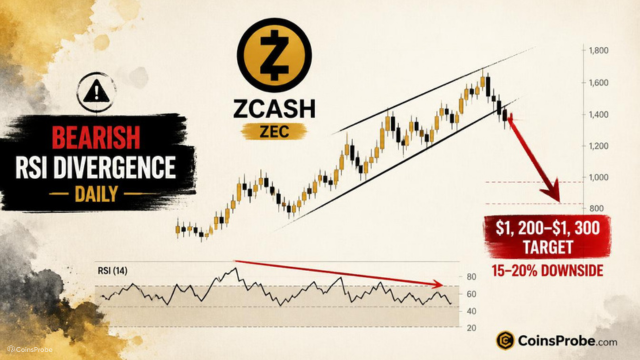
F2Pool co-founder Chun Wang criticized Zcash on September 8 as ZEC traded near $1,130 after a sharp rally pushed the privacy coin into the cryptocurrency market’s top 10. Wang, who posts unde
F2Pool co-founder Chun Wang criticized Zcash on September 8 as ZEC traded near $1,130 after a sharp rally pushed the privacy coin into the cryptocurrency market’s top 10. Wang, who posts under the name Chun on X, described the move as a “narrative bid” and questioned whether the coin’s recent rise was supported by its underlying value.
Wang pointed to Zcash’s early funding history, its optional privacy system, past governance disputes and the Orchard vulnerability disclosed earlier this year. His comments are opinions and do not show evidence of wrongdoing, while some of the issues he raised have changed over time, including Zcash’s approach to funding and the use of its privacy features.
Why ZEC is rallying while the rest of the market lags
The Zcash rally is part of a renewed interest in privacy-focused cryptocurrencies, a sector that has struggled for years with regulatory pressure and limited access to major exchanges. That makes the size of ZEC’s recent move notable because privacy coins have generally remained outside the main institutional crypto trade dominated by Bitcoin and Ethereum.
The launch of Grayscale’s Zcash ETF has also given investors a new way to gain exposure to ZEC through traditional markets. The product removes the need for investors to buy and hold the cryptocurrency themselves, which could bring a different group of buyers into the market.
Supply is another factor, Zcash has a maximum supply of 21 million coins, matching Bitcoin’s supply limit. When demand rises quickly while the amount of available coins remains limited, the price can move sharply, especially in a market where trading activity is much smaller than Bitcoin’s.
The rally therefore does not automatically mean that Zcash’s network has become more valuable at the same speed. It may show that investors are placing a much higher value on the privacy-coin story. The key question is whether that interest produces lasting demand or fades once the current market excitement disappears.
Also Read: XRPL Debate Highlights XRP’s Future Role Alongside Stablecoins in Payments and DeFi
Zcash supporters push back against the criticism
An X user, called Apollo, challenged the criticism of Zcash’s origins and value, arguing that the project cannot be treated as a token that appeared “out of thin air.” He described Zcash as “encrypted money at planetary scale” and argued that it is more decentralized than Bitcoin. Pointing to Tachyon, Valar, Shield Labs, Zodl and the Zcash Foundation as teams contributing to the ecosystem.
He further argued that Zcash’s development funding was used to advance its cryptography. That token holders now have a role in deciding how some development funds are used, arguing that Zcash’s privacy tools have continued to develop, pointing to wallets such as Zodl and Vizor, which offer private-by-default transactions. He also compared Zcash with Monero and criticised Monero’s privacy design, while making separate allegations about its former developer.
Another X user, @obcidian77, took a more market-focused view, saying the criticism around Zcash’s past issues was overstated and arguing that the token still has room to rise. He noted that ZEC remains behind XRP and TRX by market value and said heavily criticised assets can continue to perform well during crypto rallies.
Meanwhile, Zcash developers have successfully patched a critical vulnerability that could have allowed attackers to create unlimited counterfeit ZEC, with the privacy-focused cryptocurrency rebounding sharply after the disclosure triggered a major market selloff.
Can privacy coins become a major crypto investment theme?
Privacy remains one of the biggest problems in crypto, Bitcoin transactions are recorded publicly, allowing blockchain companies and other users to follow the movement of funds between addresses. That transparency is useful for tracking transactions, but it also means crypto users cannot expect the same level of financial privacy available with cash.
Zcash and Monero have taken different approaches to this problem. Zcash allows users to make private transactions using zero-knowledge technology, while Monero makes privacy a standard part of its transactions. The difference gives investors two competing models for how private digital money should work.
The opportunity could grow if more people become concerned about companies, governments and blockchain tracking firms being able to connect crypto wallets with real identities. More businesses may also want to keep payments and financial information away from public blockchains as crypto becomes more widely used.
Regulation is the biggest limit to this theme as governments and exchanges have often treated privacy-focused assets more carefully because transactions that cannot easily be traced can make compliance and financial monitoring harder. This creates a difficult balance for privacy coins because greater demand for privacy could increase their value, while greater regulatory pressure could restrict where they can be traded.
For Zcash, the long-term test is to become more than a crypto narrative and turn into something people regularly use. If that happens, the market may have a stronger reason to support a higher valuation, but if demand remains mostly driven by trading interest, ZEC’s recent price surge could prove difficult to sustain.
Enjoyed this? BookmarkDeFi Planet, explore related topics, and follow us onTwitter,LinkedIn,Facebook,Instagram,Threads, and CoinMarketCap Community for seamless access to high-quality industry insights
Take control of your crypto portfolio with DEFI PLANET PRO, DeFi Planet’s suite of analytics tools.
The post Zcash Rally Faces Scrutiny as F2Pool Co-Founder Questions Its $1,000 Valuation appeared first on DeFi Planet.