Somewhere in San Francisco this week, an OpenAI marketing executive typed dot.com into a browser and watched it load the download page for Elon Musk's Grok. That is the situation OpenAI woke
Somewhere in San Francisco this week, an OpenAI marketing executive typed dot.com into a browser and watched it load the download page for Elon Musk's Grok.
That is the situation OpenAI woke up to after its Sept. 29 DevDay, where the company introduced Dots, the product it is betting will carry it into the next phase of AI.
Dots are personal agents built on GPT-6 Astra that chase goals you set without constant supervision. OpenAI's pitch: start with one Dot, and eventually run "teams of Dots working together on your behalf."
How Elon Musk became important for crypto (2:59)
It is the company's clearest statement yet that the chatbot era is ending and the agent era is starting.
And the single most natural web address for it delivers people to the competition.
Related: You can now buy coffee with Bitcoin across U.S.
What happens if you type dot.com
Grok is the chatbot built by xAI, the AI company Musk founded in 2023 and folded together with X, his social platform. It is OpenAI's loudest competitor, in no small part because of who owns it.
Within hours of the Dots announcement, an anonymous X account called @birdabo, and longtime xAI watcher, spotted something and posted it:
"AHAHAHAHAHAHAHAHAHAHAHA NO WAY. OpenAI just announced Dots. SpaceXAI bought [dot.com]. it redirects straight to the Grok Bot download page. based lmao."
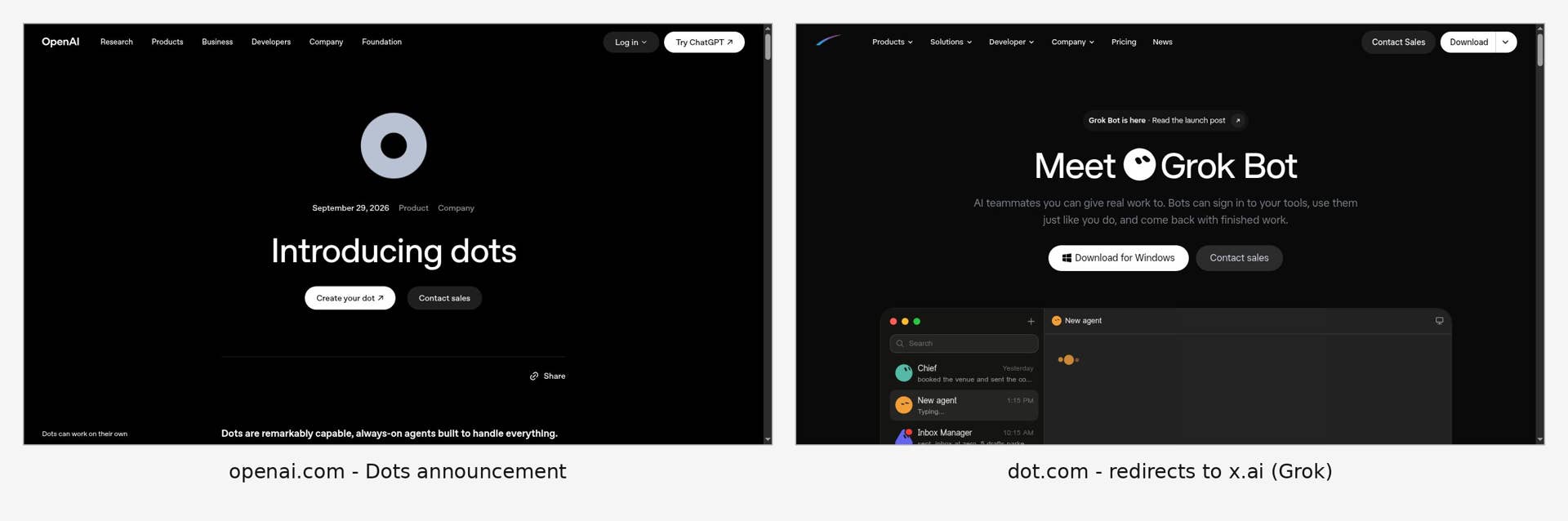
OpenAI's Dots page on the left, where dot.com actually lands on the right. Screengrab: TheStreet Roundtable
Per the Whois domain registry, dot.com transferred to xAI in July, months before the public knew what OpenAI planned to call its agents. Type it today and you land on Grok's download page.
There is no evidence xAI bought the domain to ambush this launch, and the company has said nothing about the timing. Maybe xAI collected a famous three-letter domain for its own reasons and got handed the trolling opportunity of the year by pure luck.
However, the internet, surveying ten years of history between these two men, has declined to believe that.
The worst breakup in tech
Musk and Sam Altman started OpenAI together in 2015 as a nonprofit meant to keep powerful AI out of any one company's hands.
The partnership lasted three years. Musk walked off the board in 2018 after fights over money and control, declaring on his way out that OpenAI had a "0%" chance of mattering against Google without far more funding.
OpenAI then built ChatGPT and became the most talked-about company on earth.
Musk built xAI to compete with it, and in 2024 sued OpenAI, Altman and co-founder Greg Brockman for abandoning the nonprofit mission he helped write. A federal jury threw the case out in May 2026 on statute-of-limitations grounds.
Court didn't settle anything. In July, Musk accused Altman of taking "scamming to a whole new level."
Trending on TheStreet Roundtable:
Altman has also disputed Musk’s version of their split.
Testifying in May, he said OpenAI was “kind of left for dead” when Musk departed. Musk had written in 2018 that OpenAI had a “0%” chance of becoming relevant against Google without a dramatic increase in funding.
Editor's inputs: A redirect costs xAI nothing to maintain and nothing to defend. It needed no press release. Every reporter writing about Dots this week typed dot.com, landed on Grok and gave Musk a paragraph in OpenAI's launch coverage, including this one.
Related: Roundtable 100 analysts move Ethereum 34 places higher