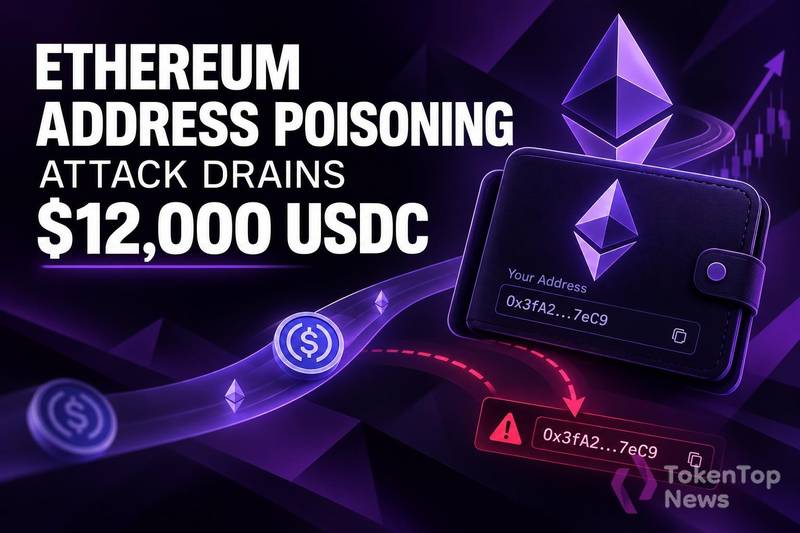
An Ethereum address-poisoning attack drained $12,000 in USDC from a victim who sent funds to a lookalike wallet address, according to a report flagged by on-chain security monitor ScamSniffer
An Ethereum address-poisoning attack drained $12,000 in USDC from a victim who sent funds to a lookalike wallet address, according to a report flagged by on-chain security monitor ScamSniffer. The incident is a textbook example of a social-engineering technique that exploits how wallets display transaction history, costing users real money with no recourse once the transfer confirms on-chain.
What happened in the $12,000 USDC Ethereum transfer
The attacker sent a zero-value or dust transaction to the victim's wallet from an address crafted to mimic a trusted counterpart, sharing the same first and last characters. When the victim later needed to send $12,000 in USDC to that counterpart, they copied the poisoned address from their transaction history rather than from a verified source. For related coverage, see 3x Bitcoin & Ethereum ETF Exposure After SEC Approval.
USDC is a regulated dollar-pegged stablecoin issued by Circle and operates natively on Ethereum. Once the transfer confirmed on the Ethereum blockchain, the funds were irreversibly gone. On-chain transactions have no chargeback mechanism, making this class of attack especially damaging compared with traditional payment fraud. For related coverage, see SEC Approves First 3x Leveraged Bitcoin and Ethereum ETFs.
This loss echoes a far larger incident in which a crypto user lost $600,000 in USDC to an address-poisoning attack, demonstrating that the tactic scales from small retail transfers to six-figure institutional movements. For related coverage, see 3x Bitcoin ETF Approved by SEC: Market Impact Explained.
How address poisoning tricks Ethereum users
The look-alike address tactic
Ethereum addresses are 42-character hexadecimal strings. Most wallets and block explorers display only the first six and last four characters, which means two addresses can appear identical at a glance while differing in the 32 characters hidden in the middle. Attackers generate vanity addresses that match those visible fragments using brute-force tooling, then send a dust transaction to seed their fake address into the victim's history. For related coverage, see Remittix (RTX) Review 2026: The Crypto-to-Fiat Payment Protocol Redefining Cross-Border Transfers.
Why copying from transaction history is risky
The poisoning depends on a common, understandable habit: reusing an address seen in a previous successful transfer. When a victim scrolls their wallet's activity feed to find a recipient, the attacker's lookalike entry sits above or near the legitimate one. A single misread, or no read at all, sends the funds to the wrong wallet. The attacker never needs access to the victim's private keys or seed phrase.
Before signing any USDC transfer on Ethereum, the sender should expand the full destination address and compare every character against a trusted source, such as a saved contact, an official website, or a previously verified communication channel. A visual spot-check of only the first and last characters is the exact assumption this attack exploits.
Steps to prevent an address-poisoning loss
The $12,000 USDC theft is preventable with a short checklist applied to every outbound transfer:
- Verify the complete address from a trusted source. Copy the destination from an official website, a saved address book entry, or a direct message from the recipient, not from your transaction history.
- Use your wallet's address book or contact feature. Saving a verified address under a label eliminates the need to copy from history and removes the attack surface entirely.
- Send a small test transaction first. For any new or infrequent recipient, send a nominal amount and confirm receipt before sending the full sum. The extra fee is far cheaper than a total loss.
- Review the full destination address before signing. Expand the address field in your wallet or review the raw transaction data. Confirm every character, not just the visible prefix and suffix.
Address-poisoning attacks require no hacking skill beyond generating a vanity address, which makes them cheap to execute at scale. As USDC usage on Ethereum grows, the tactic will continue targeting users who rely on transaction history as a shortcut. Treating every outbound transfer as a fresh verification step is the only reliable defense.
Disclaimer: This article is for informational purposes only and does not constitute financial or investment advice. Cryptocurrency and digital asset markets carry significant risk. Always do your own research before making decisions.
Read original article on tokentopnews.com