How Does STON.fi Combine Cross-Chain Swaps and TON Liquidity Aggregation? Getting your money onto TON and actually finding a good price once it's there have always been treated as two separat
How Does STON.fi Combine Cross-Chain Swaps and TON Liquidity Aggregation?
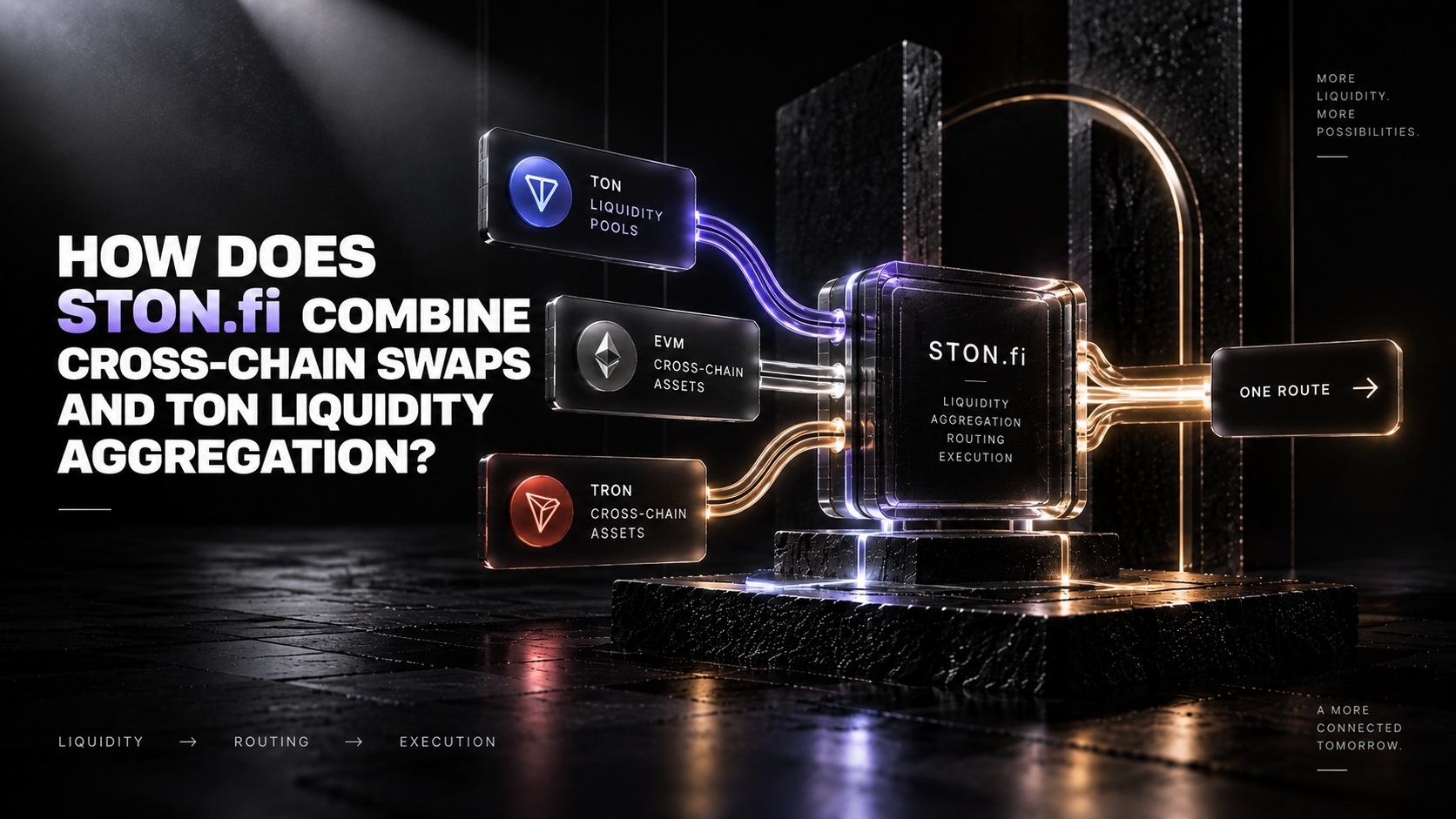
Getting your money onto TON and actually finding a good price once it's there have always been treated as two separate problems, solved by two separate tools. STON.fi's interface is built around the observation that, from the user's chair, they're really just one continuous trip.
Picture the actual sequence someone goes through: they're holding a stablecoin on some other network, and what they actually want, several steps later, is a specific TON jetton. Historically, that journey meant stitching together two entirely different toolkits — a bridge or cross-chain service to get value onto TON, then a separate DEX, opened separately, to actually find and execute the trade once they'd arrived. STON.fi treats that as one flow instead of two, using Omniston twice in a row for two different jobs: once to coordinate the cross-chain leg, and again to aggregate TON-side liquidity for whatever comes next.
💭 It's tempting to describe this as "everything in one app," and I want to resist that framing a little — it's not that STON.fi does everything. It's that the two specific problems most people actually hit back-to-back — get value onto TON, then find the best route once there — happen to be solved by the same underlying routing layer, so the interface doesn't force a context switch between them.
🧩 Two Problems That Usually Get Solved Separately
It's worth naming these as genuinely distinct problems, because conflating them is exactly what makes "cross-chain plus DeFi" sound like marketing rather than a real user journey:
- Moving value between networks. A stablecoin sitting on Ethereum, TRON, or another chain isn't natively usable on TON — it has to arrive there first, through some coordinated cross-chain mechanism.
- Finding liquidity once you're on TON. TON's own DeFi liquidity is fragmented across multiple DEXs and pools — STON.fi's own, plus others like DeDust, Tonco, and swap.coffee — none of which are required to price the same pair identically.
Historically, solving the first problem told you nothing about how to solve the second. A bridge gets you onto a chain; it has no opinion on which pool offers the best rate once you're there. That gap — arriving on TON and then having to separately go shopping for liquidity — is precisely the seam STON.fi's combined flow removes.
🌉 Step One: Landing in USDT on TON
The entry point is a supported cross-chain route — for example, moving USDT from TRON into USDT on TON. This isn't a same-chain swap; it's a coordinated cross-chain execution, handled through Omniston's resolver-based settlement rather than a traditional lock-and-mint bridge. The practical experience is a single quote and a single confirmation, even though two separate blockchains are involved in actually completing it.
What matters for this specific topic isn't re-explaining the cross-chain mechanics in depth — it's what happens the moment that leg completes: the user now holds a genuine, TON-native asset in the same wallet, inside the same interface they just used to bring it there. Nothing about that first step required opening a second application to continue.
🔀 Step Two: The Same Interface Switches Jobs, Not Apps
Once USDT is sitting on TON, the second problem appears — and it's a same-chain problem now, not a cross-chain one. Omniston shifts roles at this point: rather than coordinating settlement across two chains, it aggregates liquidity across multiple connected TON sources for whatever the user wants to do next, comparing routes rather than requiring the user to manually check each DEX in turn.

The user doesn't need to know that the underlying job changed — from their perspective, they entered one trade and are now making another, inside the same screen, without re-connecting a wallet or re-establishing trust in a new interface.
🧭 A Concrete Two-Step Example
Walking through it end to end makes the continuity concrete rather than abstract:
- Start: the user holds USDT on TRON and wants exposure to a specific TON jetton.
- Cross-chain leg: they request a swap from TRON/USDT into TON/USDT, review the quote, fees, and destination wallet, and confirm — Omniston coordinates the cross-chain settlement.
- Arrival: USDT now sits on TON, in the same wallet, inside the same STON.fi session.
- TON-side leg: without leaving the app, they request a second swap — TON/USDT into the target jetton — and Omniston now aggregates across connected TON liquidity sources to find the best available route for that pair.
- Result: two genuinely different problems — cross-network movement, then same-chain liquidity discovery — solved through two swaps, in one continuous session, without a new app, a new wallet connection, or a new trust decision in between.
🔒 Why "One Flow" Doesn't Mean "Less Self-Custodial"
It's worth being explicit about what doesn't change across this combined flow: at no point does STON.fi take custody of the funds involved. Each leg — the cross-chain swap and the TON-side swap — is still its own explicitly signed action from the user's own wallet. Convenience here comes from not having to re-establish context (a new app, a new connection, a new set of unfamiliar screens) between two actions, not from handing over any additional control. The self-custodial model that governs a single same-chain swap governs both steps of this combined journey equally.
✅ A Checklist for Actually Doing This
Before treating any specific cross-chain route as available, it's worth checking live conditions rather than assuming coverage — supported networks and assets can expand or shift over time. A practical checklist for this exact two-step journey:
- Confirm the specific source network and asset are actually supported for the cross-chain leg right now, in the live interface.
- Review the cross-chain quote in full — fees, destination network, destination wallet — before confirming the first leg.
- Once USDT (or the relevant asset) arrives on TON, check the second swap's quote independently — a good cross-chain rate doesn't guarantee the best TON-side route on its own.
- Compare the final TON-side quote's output and price impact, not just a headline rate, since that's what Omniston's aggregation is actually optimizing for.
- Treat the two legs as two separate decisions worth reviewing individually, even though they happen in immediate succession.
🧭 Conclusion
The value in combining cross-chain swaps and TON liquidity aggregation isn't a "does everything" claim — it's that two problems which happen to arrive back-to-back for a lot of users are solved by the same underlying routing layer, inside the same interface, without forcing a context switch between them. Getting a stablecoin onto TON and then finding the best route once there were never actually one problem — but they're commonly one sequence, and STON.fi's flow reflects that sequence rather than treating each half as belonging to an unrelated tool.
❓ Frequently Asked Questions
Does using both the cross-chain and TON-side swap in one session change how self-custodial the process is?No. Each leg remains an independently signed transaction from the user's own wallet. Convenience here means not switching apps or re-establishing context between steps — it doesn't mean STON.fi takes on any custody it wouldn't otherwise have.
Is every cross-chain route guaranteed to connect smoothly into a TON-side swap afterward?The cross-chain leg and the TON-side leg are functionally independent — once an asset like USDT arrives on TON, it can be used in any TON-side swap Omniston can route, not just ones tied to where it originally came from. Always verify the specific cross-chain route is currently supported before relying on it.
Why does Omniston need to do two different jobs instead of one consistent thing?Because the two problems are genuinely different: cross-chain settlement has to coordinate two independent blockchains that can't natively verify each other's state, while same-chain aggregation is comparing multiple liquidity sources that already share one chain's state. The routing logic differs because the underlying problem differs.
Is this meant to replace checking each swap's quote individually?No — if anything, the opposite. Each leg still has its own quote worth reviewing on its own terms; a good cross-chain rate says nothing about whether the following TON-side route is the best available one.