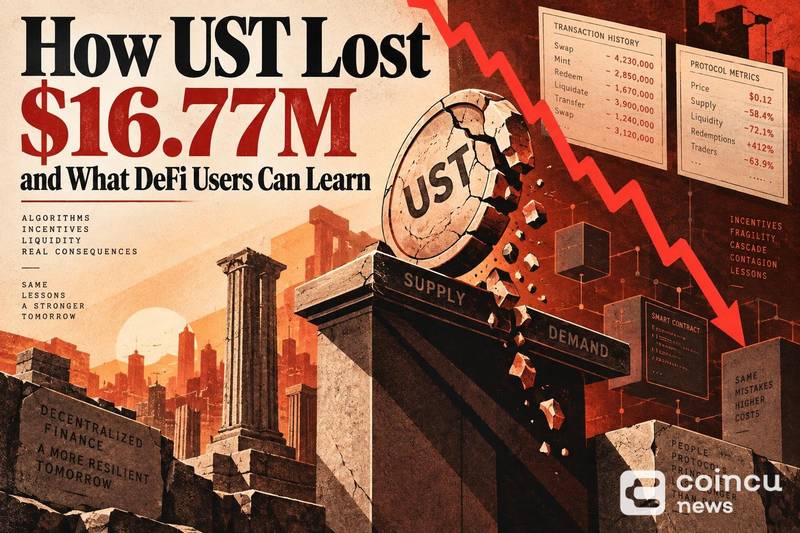
A reported $16.77 million loss involving UST, flagged by blockchain security monitor PeckShield, has renewed scrutiny of the trust assumptions embedded in stablecoin-based DeFi activity, wher
A reported $16.77 million loss involving UST, flagged by blockchain security monitor PeckShield, has renewed scrutiny of the trust assumptions embedded in stablecoin-based DeFi activity, where nominally stable assets can still expose users to smart-contract, liquidity, and approval risk at every transaction layer.
What Is Confirmed and What Is Not
The $16.77M figure originates from a PeckShield alert, a security firm that monitors on-chain activity across major networks. As of publication, the specific protocol involved, the transaction path, and the root cause remain unverified; the incident details should be treated as a single-source report pending on-chain confirmation and an official statement from any affected project. As prior UST-linked losses have demonstrated, the gap between an alert and a confirmed incident can be significant, and attributing blame before evidence supports it compounds confusion.
What on-chain analysis has consistently shown across DeFi incidents is that the loss path matters as much as the loss amount. Whether the root cause is a smart-contract exploit, a compromised approval, a bridge failure, or an operational error determines which users are exposed and whether any recovery mechanism exists. For related coverage, see BTC Spot ETF Outflows Continue With $227M Lost Over Three Days.
How UST Users Become Exposed to This Risk
Stablecoin activity in DeFi is rarely a direct peer-to-peer transfer. A single transaction can pass through a liquidity pool, a lending protocol, a cross-chain bridge, and a custody layer before settling, with each hop introducing a distinct trust assumption. A user who approves a contract interaction grants that contract recurring access to their wallet balance until the approval is explicitly revoked, a dependency that persists even after the user exits the protocol. For related coverage, see South Korean Police Trace Polymarket Users in $12.7M Betting Case.
UST's prior history, including the reported $136M loss event that preceded this alert, underlines that algorithmic and semi-collateralized stablecoins carry redemption-mechanism risk that fully collateralized assets do not. Composability, the feature that allows DeFi protocols to stack atop one another, amplifies this: a failure in one underlying contract can propagate losses upward through every protocol that depends on it.
Practical Risk Controls for DeFi Users
The immediate priority for any user who interacted with UST-denominated pools or lending markets recently is to audit outstanding wallet approvals using a tool such as Etherscan's token approval checker or Revoke.cash, and to revoke any permissions granted to unfamiliar or inactive contracts. Phishing campaigns reliably follow high-profile DeFi losses, so any unsolicited message offering compensation or recovery assistance should be treated as hostile until verified through the official project's primary channels.
Position sizing is the structural control that approval audits cannot replace. Concentrating a portfolio in a single stablecoin or a single protocol eliminates the exit-liquidity optionality that allows users to reduce exposure when on-chain signals deteriorate. The $16.77M figure, unverified as the causal details are, illustrates that losses in DeFi are not bounded by a protocol's stated purpose; a stablecoin position can generate a nine-figure loss if the trust stack beneath it fails. Broader patterns, such as the $320M Liquid Network loss, reinforce that loss events are not outliers confined to poorly audited protocols.
Questions to Ask Before Depositing or Bridging
Before any stablecoin deposit, four questions bound the risk surface: Has the contract been audited, and by whom? What happens to funds if the protocol pauses or is exploited? Is there an exit window with adequate liquidity, or does redemption depend on counterparty availability? And what approvals persist after the transaction closes? These are not rhetorical; each has a verifiable answer from the project's documentation or on-chain state.
Warning signs that warrant immediate position review include: governance proposals that modify collateral parameters without a timelock, unusually high utilization rates in lending pools (which compress exit liquidity), and cross-chain bridge outflows that do not have a corresponding inflow on the destination chain within the expected settlement window.
FAQ: UST and DeFi Loss Risk
Did UST itself lose $16.77M, or did a user or protocol lose funds?
Per the PeckShield report, the loss is attributed to activity involving UST, but whether the affected party is an individual wallet, a liquidity pool, or a protocol treasury has not been confirmed as of publication. The distinction matters for understanding which recovery mechanisms, if any, apply.
How can I check whether my wallet is affected?
Search your wallet address on the relevant block explorer (Etherscan for Ethereum-based assets, BscScan for BNB Chain) and review recent transactions against the protocol addresses once those are publicly identified. Do not rely on third-party recovery services promoted through social media or direct messages.
Does this mean all stablecoins or DeFi protocols are unsafe?
No. Loss events are protocol-specific, and risk varies substantially based on collateral structure, audit history, and governance design. The appropriate response to a single incident is a targeted review of similar exposure, not a blanket exit from DeFi.
What should I do if I interacted with the affected protocol?
Revoke active approvals, monitor your wallet for unauthorized transactions, and wait for a verified post-mortem from the project before taking recovery actions. Acting on unverified recovery instructions is the primary vector for secondary losses after an incident.
Additional source references: source document 1, source document 2.
Disclaimer: This article is for informational purposes only and does not constitute financial or investment advice. Cryptocurrency and digital asset markets carry significant risk. Always do your own research before making decisions.
The post How UST Lost $16.77M—and What DeFi Users Can Learn was initially published on Coincu.