Ledger has confirmed that an unauthorized hardware implant was discovered inside a customer-owned device during a wallet-theft investigation, raising pointed questions about physical supply-c
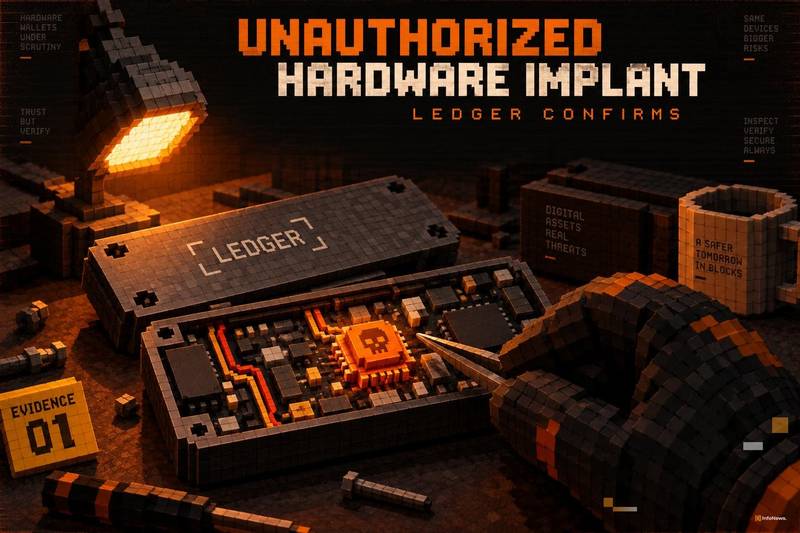
Ledger has confirmed that an unauthorized hardware implant was discovered inside a customer-owned device during a wallet-theft investigation, raising pointed questions about physical supply-chain integrity for hardware wallets and the security assumptions users place in sealed consumer devices.
The confirmation marks a rare acknowledgment from a major hardware-wallet manufacturer that a physical device reached an end user in a modified state. Whether the implant was introduced before or after the device left the supply chain has not been established in available reporting, and Ledger has not publicly attributed the modification to a specific actor or stage in the distribution process. For related coverage, see Ledger Launches Morpho Loans Using Wrapped Bitcoin as Collateral.
The discovery is framed as an investigative finding rather than a broad product recall. The available information does not establish that the implant is present in other devices or that a systematic compromise of the manufacturing or reseller chain has been confirmed. Users should treat that distinction carefully: a confirmed finding in one device is not, on its own, evidence of a wider campaign, though it cannot rule one out either. For related coverage, see Bitcoin & Ether Order Books Rebuild as Altcoin Liquidity Thins.
What an Unauthorized Hardware Implant Means for Device Integrity
A hardware implant, in this context, refers to an unauthorized physical component added to a device without the knowledge of the manufacturer or the owner. Such a component can potentially intercept signing operations, exfiltrate seed-phrase data, or introduce exploitable logic beneath the level of firmware or software security controls. Because it operates at the hardware layer, standard firmware verification and software-side audits may not detect it.
The wallet-theft investigation that preceded this discovery links the finding directly to a financial loss, though the causal relationship between the implant and any theft has not been independently confirmed in available reporting. Investigators examining a compromised device identified the component; that sequence does not, by itself, prove the implant was the mechanism of the theft.
Ledger devices have appeared at the center of several high-value loss events in recent cycles. A wallet drain totaling $92.9 million across Bitcoin, Ethereum, and TRON was tied to Ledger-related exposure, and a separate incident saw CZ urge wallet quarantine following an $86 million Ledger reseller hack. Those events involved software-layer and reseller-channel compromises; a hardware implant would represent a distinct and more invasive attack vector.
Reseller-channel exposure has already proved consequential: a hacker connected to the Ledger reseller incident later moved $1.07 million in ETH to Tornado Cash and $270,000 to Binance, illustrating that losses from supply-chain attacks translate quickly into on-chain laundering activity.
What Ledger Users Should Know
Two points are supported by the available information and are directly relevant to anyone holding assets on a Ledger device.
First, Ledger confirmed that an unauthorized hardware implant was found in a customer device during a wallet-theft investigation. That confirmation is the verified development; the scope, cause, and full technical details remain part of an ongoing investigation.
Second, the available information does not establish broader user impact, and no public advisory has confirmed that other devices in circulation carry similar modifications. Users who obtained their devices through unofficial resellers or second-hand markets carry meaningfully higher risk exposure than those who purchased directly, a concern that predates this specific finding.
For Bitcoin holders specifically, the properties that make self-custody valuable, namely the removal of counterparty risk, depend entirely on the integrity of the signing device. A compromised hardware layer eliminates those guarantees regardless of how strong the firmware or passphrase configuration is. Users with any uncertainty about device provenance should treat the device as potentially compromised and migrate funds to a device with a verified, unbroken chain of custody before signing further transactions.
Additional source references: source document 1, source document 2.
Disclaimer: This article is for informational purposes only and does not constitute financial or investment advice. Cryptocurrency and digital asset markets carry significant risk. Always do your own research before making decisions.
Bitcoininfonews first published the article titled Ledger Confirms Unauthorized Hardware Implant in Customer Device.