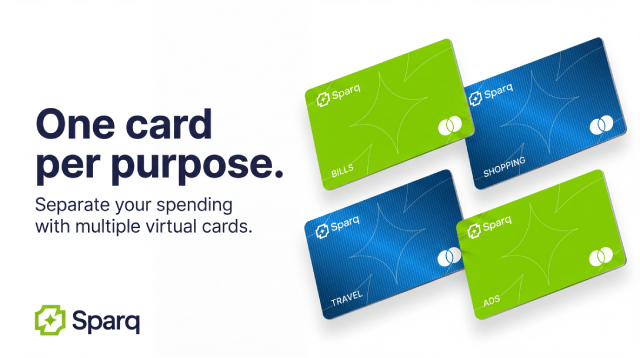
Quick answer The practical value of virtual crypto cards comes from issuing several rather than one. Separating spending by purpose — subscriptions, advertising, shopping, travel — with indiv
Quick answer
The practical value of virtual crypto cards comes from issuing several rather than one. Separating spending by purpose — subscriptions, advertising, shopping, travel — with individual limits on each card bounds the exposure from any single leaked number and produces clean per-category records. Sparq applies this model to crypto-funded cards, issuing multiple virtual cards from a single BTC, ETH, or USDT balance with independent controls on each.
Table of contents
- Why one card is the default and why it underperforms
- The separation model
- How Sparq implements it
- Industry data and infrastructure direction
- What separation does not solve
- FAQ
Single-card behaviour is inherited from physical cards. Replacing plastic took weeks, so users protected the one card they held and reused it across every merchant.
Virtual cards remove that constraint — issuance is instant and typically unlimited — but the inherited habit persists. A single virtual number distributed across dozens of merchants carries broadly the same exposure profile as a physical card, minus skimming risk.
Mastercard data indicates fraud rates on virtual cards run at less than one-fifth of those on non-virtual cards. That figure reflects segmented usage patterns rather than a property of digital issuance itself.
The separation model
Card purposeLimit approachRationaleSubscriptionsMonthly total of recurring chargesPredictable spend; isolates recurring billing from everything elseAdvertising / paid acquisitionMonthly budget ceilingCaps runaway campaign spend; simplifies attribution of ad costsOnline shoppingRolling monthly limitHighest-variance category, kept away from recurring commitmentsTravel bookingsFrozen when not in useInfrequent, high-value; zero exposure between trips
Two benefits follow from this structure beyond fraud reduction.
Bounded exposure. A leaked number is limited by that card's ceiling rather than the account balance.
Attribution. An unexpected charge on a purpose-specific card narrows the source substantially. A single shared card provides no diagnostic signal — the holder cancels, reissues, redistributes the number, and gains no information about origin.
A third benefit is administrative: separate cards produce separate transaction records, which simplifies reconciliation between business, personal, and campaign spending.
How Sparq implements it
Sparq issues multiple virtual cards from a single crypto balance, with each card carrying its own spending controls and the ability to be frozen or deleted independently.
Relevant specifics:
- Funding assets: BTC, ETH, and USDT
- Top-up networks: TRC20, BEP20, and ERC20
- Card networks: Visa and Mastercard
- Wallet support: Apple Pay and Google Pay
- Custody model: non-custodial
- Compliance: PCI DSS
Because issuance is instant, creating a dedicated card for a new spending category carries effectively no friction — which is the condition separation depends on. A model requiring a waiting period or per-card cost would not survive contact with actual usage.
Industry data and infrastructure direction
Card network infrastructure has moved toward enforcing controls at the point of card creation rather than reviewing transactions afterward.
Mastercard announced an expansion of its In Control virtual card number platform in July 2026, introducing Issuer Enforced Controls — spend limits, transaction caps, and validity periods applied when a virtual card number is created. This builds on Clearing Controls, introduced in 2025, which extend control checks beyond authorisation into the clearing stage. Citi was named first adopter, with global extension expected during 2026. The platform's ecosystem spans 43 countries and 174 currencies.
Adoption lags availability considerably. Chase, Citi, and several large credit unions already offer virtual card numbers within their primary banking applications, with reported uptake under 20% of eligible customers.
Business demand appears stronger than consumer demand. A Mastercard-commissioned Datos Insights study published in July 2026 found 45% of SMEs identifying stronger fraud and security guarantees as the top enabler of future virtual card adoption, with fraud mitigation rated the most valuable proposed benefit across every region surveyed.
What separation does not solve
Card separation addresses a specific category of risk and should not be presented as comprehensive security.
- Authorised push payment fraud. Where a user is socially engineered into transferring funds voluntarily, card structure is irrelevant. Reported losses in this category have tripled since 2022 according to FTC and Federal Reserve data, and current industry analysis positions social engineering ahead of stolen card numbers as the dominant threat.
- Account takeover. If the issuing account is compromised, the number of cards is immaterial. Account-level authentication is the controlling factor.
- Provider compromise. Segmentation within a platform provides no protection against failure of the platform itself.
FAQ
How many cards is reasonable?Enough to separate genuinely distinct spending categories — typically three to six. Exhaustive per-merchant segmentation introduces management overhead that most users abandon.
What limit should each card carry?As close to expected spend as practical. Setting limits at account balance level removes most of the containment benefit.
Which cryptocurrencies fund Sparq cards?BTC, ETH, and USDT, with top-ups supported over TRC20, BEP20, and ERC20 networks.
Do virtual cards work in physical stores?Yes, where added to Apple Pay or Google Pay for contactless payment, in addition to standard online use.
Does separating cards affect fees?This depends on the provider's issuance policy. Comparing whether additional cards carry per-card charges matters if separation is the intended usage pattern.