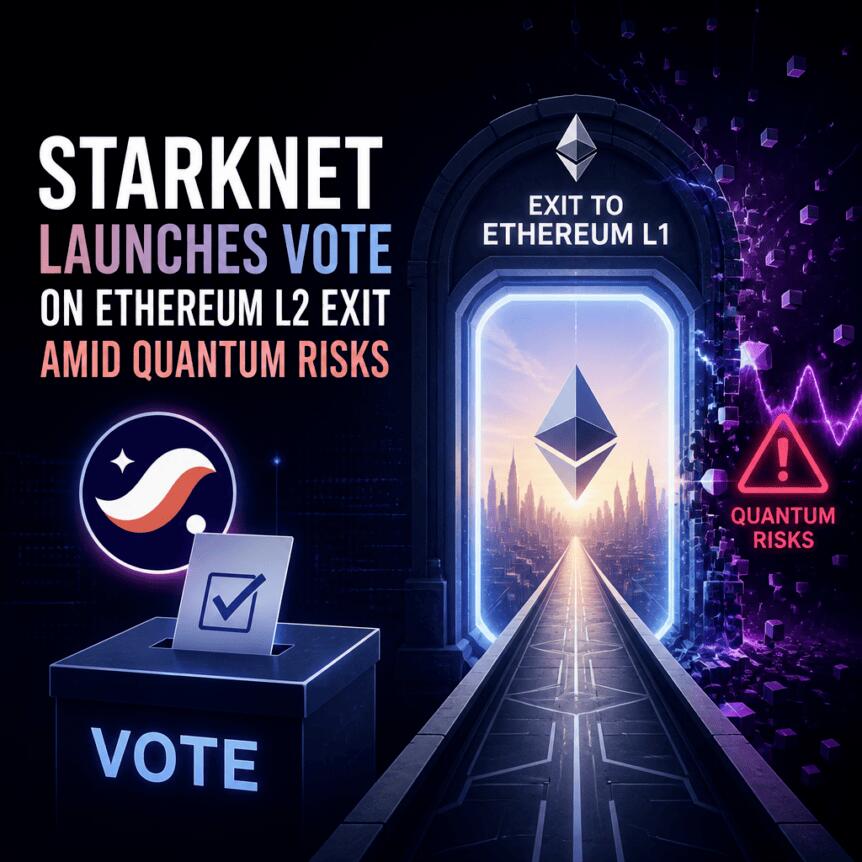
Starknet has launched a seven-day, non-binding governance vote that asks STRK holders whether the network should explore transitioning into an independent, post-quantum layer-1 blockchain. Th
Starknet has launched a seven-day, non-binding governance vote that asks STRK holders whether the network should explore transitioning into an independent, post-quantum layer-1 blockchain. The poll does not authorize a move to L1 on its own; instead, it gauges support for additional research that would later require separate governance decisions.
The initiative reflects a broader push across crypto to address quantum security concerns—particularly the risk that future quantum computing could undermine widely used cryptographic schemes. Starknet argues that achieving “quantum-resistant” security may eventually require reducing reliance on Ethereum infrastructure that it says still leaves quantum-security gaps.
Key takeaways
- Starknet’s vote is non-binding and framed as support for further research—not a direct approval of any migration to layer-1.
- The poll closes on Oct. 22, with results expected to be published afterward.
- StarkWare links the push to the need for quantum-resistant security, citing Ethereum-based dependencies such as bridge and data availability.
- StarkWare’s CEO and Starknet have previously hinted at a “first fully quantum-resistant network” target for 2027, though no timeline is attached to this vote.
A seven-day question for STRK holders
According to the Starknet governance portal, the proposal opened this Thursday and runs for seven days. Voters can select one of three options: support additional research, oppose the idea, or remain neutral until more information is available. Voting is set to end on Oct. 22, after which the network plans to publish results.
Crucially, a “Yes” vote is not a green light for execution. The proposal is designed to test whether the community wants the project to continue studying an L1 path and related technical and governance requirements. Any eventual transition would require further proposals and additional governance votes, and Starknet has not announced a timetable for becoming a layer-1.
Why Starknet wants an independent post-quantum path
StarkWare, the organization behind Starknet, says the main motivation is to pursue quantum-resistant security without being constrained by Ethereum’s upgrade cadence. In its framing of the vote, StarkWare points to Starknet’s current dependence on Ethereum for key infrastructure, identifying those components as remaining quantum-security dependencies.
Specifically, StarkWare highlights Ethereum-linked infrastructure such as the bridge and data availability. The company’s position is that if Starknet’s ultimate goal is to be “quantum-resistant” across the full stack, it may need to build or restructure elements that are currently anchored to Ethereum’s security model and its timeline for post-quantum changes.
StarkWare draws a line between urgency and upgrade schedules
In comments provided to Cointelegraph, StarkWare CEO Eli Ben-Sasson described quantum-proofing as urgent and characterized Starknet’s approach as needing speed. He contrasted what he described as faster movement on quantum security at Starknet versus slower progress—specifically referencing Ethereum and Bitcoin—in their respective approaches.
Both Ben-Sasson and Starknet have previously hinted at the concept in separate posts on X on Oct. 8. In those remarks, the proposal was presented as part of a goal to become “the first fully quantum-resistant network” by 2027. While the new governance vote does not itself set a transition schedule, it reinforces that Starknet sees governance buy-in as a step toward a longer-term architecture shift.
How this fits into the existing quantum-resistance roadmap
This governance poll comes after StarkWare laid out a three-phase quantum-resistance roadmap for Starknet in June. That roadmap, as earlier reported by Cointelegraph, covers multiple layers of work: upgrading signatures, migrating smart contracts, and addressing Ethereum-dependent infrastructure.
The new vote essentially tees up the next step of that roadmap by asking whether STRK holders want the project to explore an approach that could reduce or eliminate the Ethereum dependency that StarkWare says persists as a quantum risk.
It also arrives alongside ongoing work in Ethereum’s ecosystem. In March, Ethereum developers established a dedicated post-quantum team, with the aim of introducing initial protocol-level protections by 2029. Against that backdrop, Starknet’s current question reads less like an immediate technical plan and more like a strategic alignment decision: whether the network should pursue quantum-resilient architecture on its own terms as Ethereum progresses.
What investors and builders should watch next
For now, the most immediate signal is community direction: whether STRK holders back additional research into a post-quantum L1 trajectory. After Oct. 22, the poll’s outcome may determine how quickly Starknet turns its governance discussion into technical work—especially around replacing or redesigning Ethereum-linked components such as bridging and data availability.
This article was originally published as Starknet Launches Vote on Ethereum L2 Exit Amid Quantum Risks on Crypto Breaking News – your trusted source for crypto news, Bitcoin news, and blockchain updates.