Key Takeaways Dollar products lower the first onchain barrier. BTC can provide collateral; USDC provides liquidity. Settlement rails are moving beyond crypto exchanges. Stablecoin volume alon
Key Takeaways
- Dollar products lower the first onchain barrier.
- BTC can provide collateral; USDC provides liquidity.
- Settlement rails are moving beyond crypto exchanges.
- Stablecoin volume alone cannot prove adoption.
- Tokenized assets give onchain cash broader purpose.
For most of crypto’s history, the first decision was whether to buy Bitcoin. A company or investor can now enter the same financial system through a dollar balance, a settlement workflow, a loan against Bitcoin or a tokenized fund, without first making a bet on BTC’s price.
That is the case for a different kind of growth: dollar-denominated products can bring users, companies and capital onchain through familiar financial tasks. They may deepen the infrastructure around crypto, but they do not by themselves create demand for Bitcoin, Ether or any other volatile asset.
Why Onchain Finance Needs a Dollar Working Balance
Bitcoin can serve as an investment asset, reserve asset or collateral, but it is a difficult default unit for payroll, invoices and short-term cash management. Its price can change materially before a merchant, borrower or treasury team has completed a transaction. A dollar-pegged token solves a separate problem: it keeps the unit of account familiar while putting the transfer and settlement process on blockchain rails.
Circle’s September 21 launch illustrates the split. Eligible Circle Mint customers can use BTC-backed cirBTC as collateral to borrow USDC through third-party markets, including Morpho at launch. The borrower keeps exposure to Bitcoin; the dollar token is the liquidity they can use, account for or deploy. It is an institutional product with eligibility limits, not evidence of mass-market credit adoption, but it shows how the two assets can play different roles in the same transaction.
Payment networks are testing the same working-balance idea from the settlement side. Mastercard says it is expanding regulated stablecoin settlement capabilities, starting with USDC in select markets and adding support for PYUSD, RLUSD, SoFiUSD and other tokens through network partners. The practical use case is back-end settlement: participating financial firms can test whether some obligations can move outside conventional banking cut-off times. Mastercard describes a staged expansion, not a global live rollout.
How digital dollars fit into onchain financeEach use begins with a familiar dollar-based task, then connects to wider blockchain markets.
Send or settle a payment
Why it fitsPrices and invoices are already in fiat.
What it connects toMerchant payouts and cross-border transfers.
Hold short-term cash
Why it fitsA stable balance is easier to plan around.
What it connects toOnchain yield and tokenized Treasuries.
Borrow against crypto collateral
Why it fitsLoan size and repayment remain dollar-denominated.
What it connects toBTC-backed credit and lending markets.
Buy a tokenized financial asset
Why it fitsIt provides an onchain settlement balance.
What it connects toFunds, eligible equities and portfolio products.
Visa Onchain Analytics reported that adjusted stablecoin volume rose 58% and transactions 35% in the 12 months through August 31. Adjusted measures are more useful than raw blockchain totals because they seek to filter out some activity that can inflate the headline figures.
What the evidence can, and cannot, show
Growing stablecoin activity can show that more value is moving through onchain financial rails. It cannot show, by itself, whether those rails are becoming ordinary commerce, whether firms will keep using them, or whether the liquidity will later move into BTC, ETH or tokenized investments.
From Dollar Balances to Onchain Markets
A digital dollar becomes more useful when it can settle an investment, not only wait for the next crypto trade. That is why tokenized Treasuries, funds and certain securities matter to the stablecoin story: they can give onchain cash a use beyond transfers and crypto-exchange liquidity.
The RWA.xyz tokenized-Treasury dashboard showed about $14.94 billion in distributed value when checked on September 26. The total remains tiny beside the conventional Treasury market, but it is large enough to establish tokenized cash management as a functioning category. The harder test is whether investors can reliably enter and exit those products in secondary markets, rather than only buy new issuance.
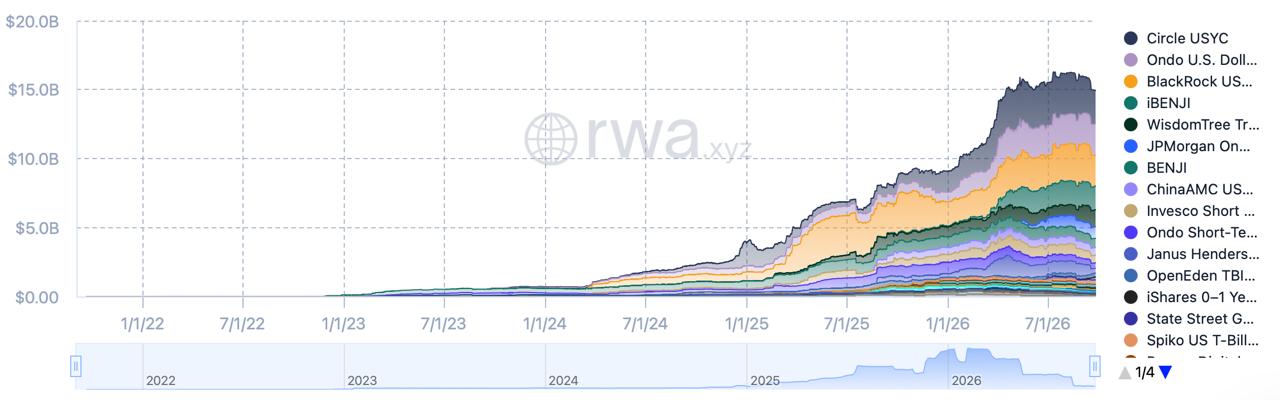
RWA.xyz tokenized Treasury market growth.
The U.S. Securities and Exchange Commission has also opened a narrow route that connects the settlement question with investment products. Its temporary Innovation Exemption allows qualifying venues to seek conditional relief for permissioned trading in certain tokenized U.S. stocks. Access, custody and shareholder rights remain central conditions; a token tracking a share price is not automatically the same as owning that share. Coindoo’s analysis of the SEC’s tokenized-stock route explains why the framework remains a controlled market test.
Where the Link to Crypto-Asset Demand Breaks
The bridge from dollar usage to a broader crypto market is indirect. Dollar products may bring firms onchain, recurring balances may justify better wallets, custody and compliance systems, and deeper infrastructure may make other assets easier to access. The final step still depends on whether users choose to deploy that liquidity into volatile tokens, tokenized securities or lending markets.
That is why stablecoin growth can remain largely inside a dollar loop. A business may use USDC for a weekend payment, while an investor may hold tokenized Treasuries for yield; neither action necessarily increases demand for Bitcoin. The more compelling adoption case would be users and institutions moving between payments, cash products, collateral and regulated investment markets—not simply holding a larger stablecoin balance.
There is a methodological reason for caution too. McKinsey has warned that headline stablecoin transaction totals can overstate real economic use because trading, internal transfers and automated activity are mixed into the data. Higher volume can be meaningful without proving that blockchain payments have become a broad consumer habit.
Even if payment and investment use widens, a separate question remains: what legal claim, redemption right and operational protection does each onchain dollar actually give its holder?
READ MORE:
 Bitget Wallets Flagged in Suspected $170M Security Breach
Growth Does Not Remove the New Risks
Moving dollars onchain does not make them risk-free. Stablecoins still depend on issuer reserves, redemption arrangements, legal claims and banking access. Tokenized assets may add transfer restrictions, thin liquidity and rights that differ from the asset they reference. The Bank for International Settlements has argued that programmable money can improve settlement and collateral movement while leaving difficult questions around redemption, interoperability, integrity and the role of issuers.
The useful comparison is therefore not “crypto versus banks.” It is whether a particular onchain product offers a clearer, cheaper or more flexible service than the existing alternative, and whether its legal and operational protections are clear before something goes wrong.
What Would Show That the Shift Is Real?
The evidence should show more than rising stablecoin market capitalization or a strong Bitcoin candle. A durable change would appear in several places at once:
- Better transaction quality: payment, payroll, settlement and business-transfer activity growing alongside trading flows;
- Production use: card, bank and treasury products moving beyond limited pilots and announcements;
- Secondary liquidity: tokenized Treasury, fund and equity products becoming easier to buy and sell;
- Institutional behaviour: companies using onchain dollars for ordinary treasury and collateral operations;
- Clearer protections: workable rules on redemption, custody, disclosures and investor rights.
The Next On-Ramp May Not Look Like Crypto
Bitcoin can remain central to a future expansion without being the product that starts it. The next user may arrive through a corporate settlement tool, a regulated fund, a dollar balance in a wallet, or a loan secured by assets they already own.
If digital dollars become a normal tool for paying, settling, managing cash, and investing, crypto’s growth will be built on dollars, not Bitcoin. Whether that foundation later supports speculative demand for volatile tokens will depend on risk appetite and investment decisions. The decisive test comes earlier: whether a dollar balance onchain turns into repeatable financial activity rather than simply a larger stablecoin supply.
The post Crypto’s Next Growth Phase May Be Built on Dollars, Not Bitcoin appeared first on Coindoo.
